A few notes from the Overland Expo

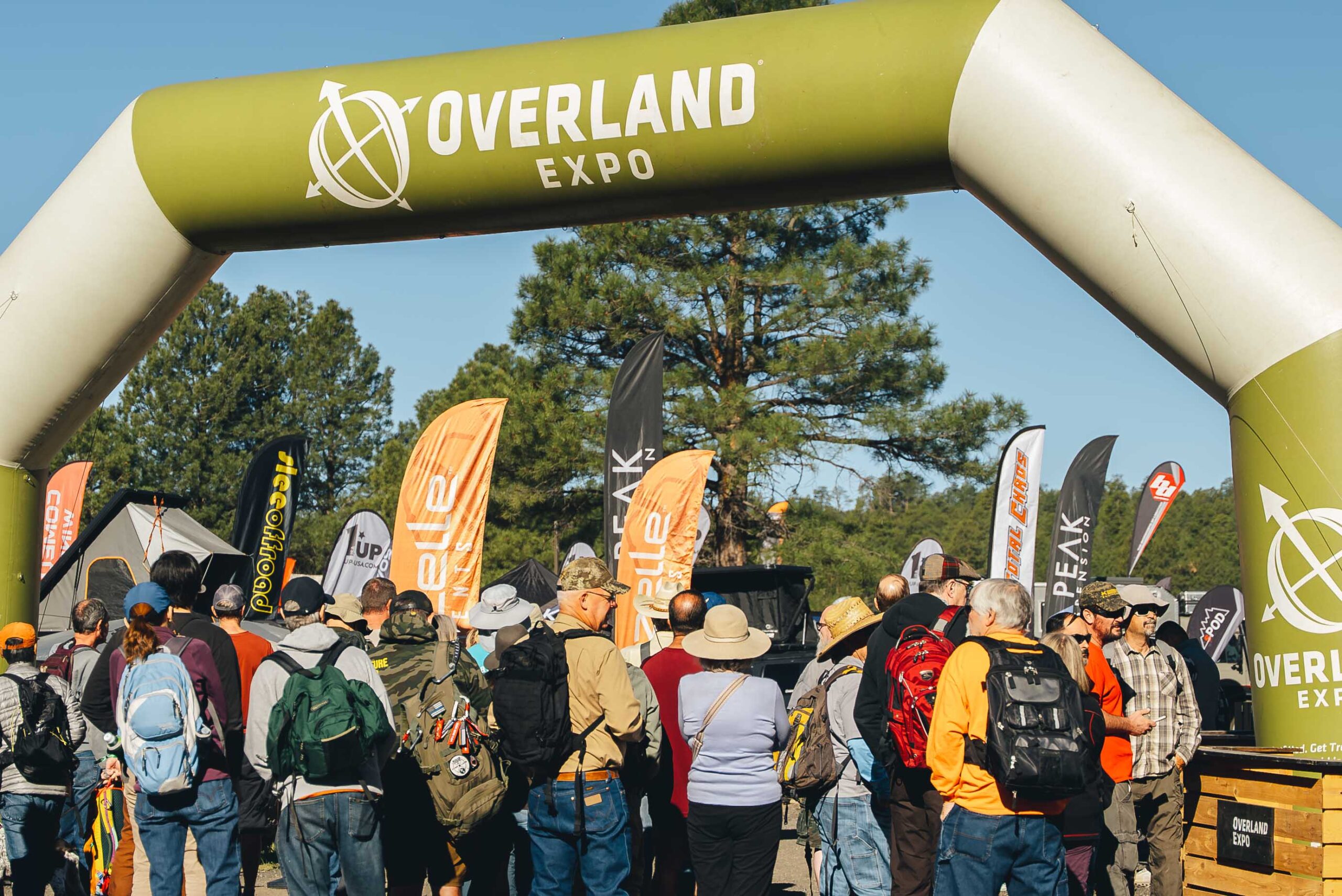
Full disclosure: I am not actually an Overlander guy and I doubt I would become one even if I had the money. It just doesn’t take that much to get off of the beaten path. However, many others see it differently, and the market that emerged from this worldview created the Overland Expo which was recently encamped in Flagstaff.

https://www.overlandexpo.com/photo-gallery/overland-expo-west-2025-friday-photos/

My wife and I went, and while we paid to shop, essentially, we had a discount through some means I do not recall.

Amateur but veteran tip: we parked at NAU and took the bus in, and this was little trouble. Especially compared to a previous year where we spent so long hiking in from our found parking space that we essentially missed the event.

This is not a detailed review of what is a giant outdoor mall for people who want to see the great outdoors from the window of their expensive vehicles. We found a few cool things, and I record them here for my reference, but I share also with you.

More or less smallest to largest:

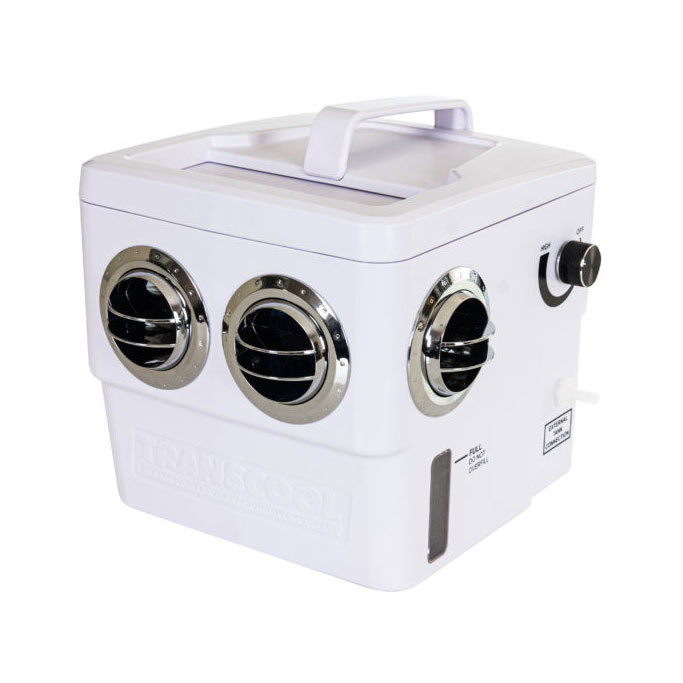
The Transcool portable evaporative cooler. A lunch-boxed sized evap cooler you can run from your car battery of other portable power. Or a wall outlet, I suppose. Couldn’t vouch for its performance in the humidity but the demo was blowing cold on a dry Flagstaff afternoon. https://transcoolusa.com/

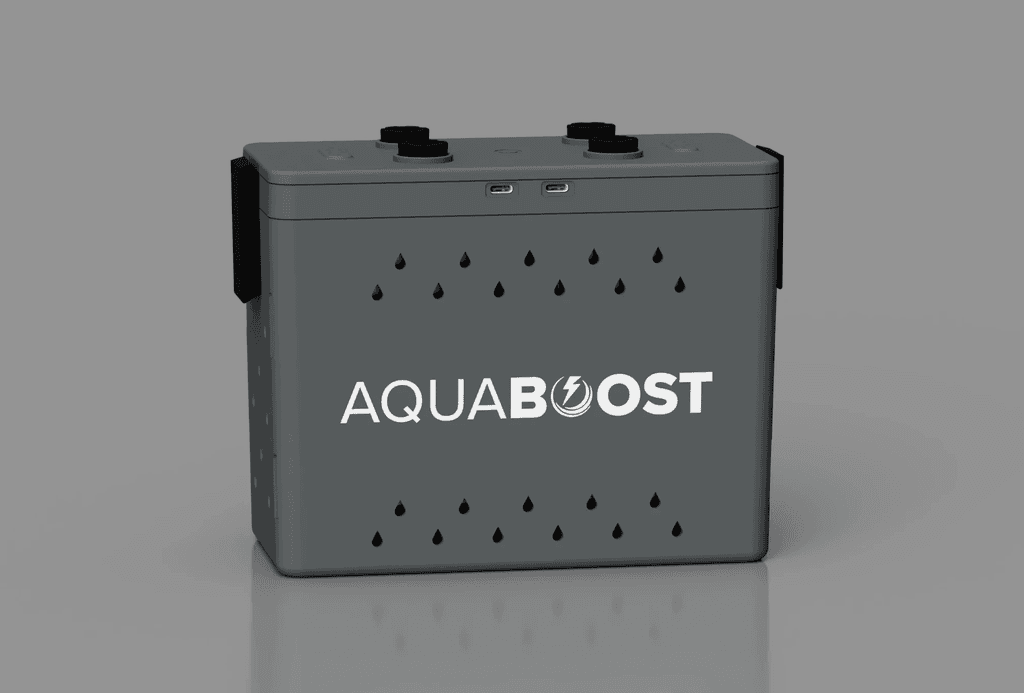
The Aquaboost power station turns salt water to electricity, perhaps to power your Transcool for up to 12 hours, per their literature.  https://www.aquaboostpower.com/

Your state parks and local tribes are trying to save history – and they gave me a sticker, so I give them a plug. https://savehistory.org/

This is tangential to a previous post.

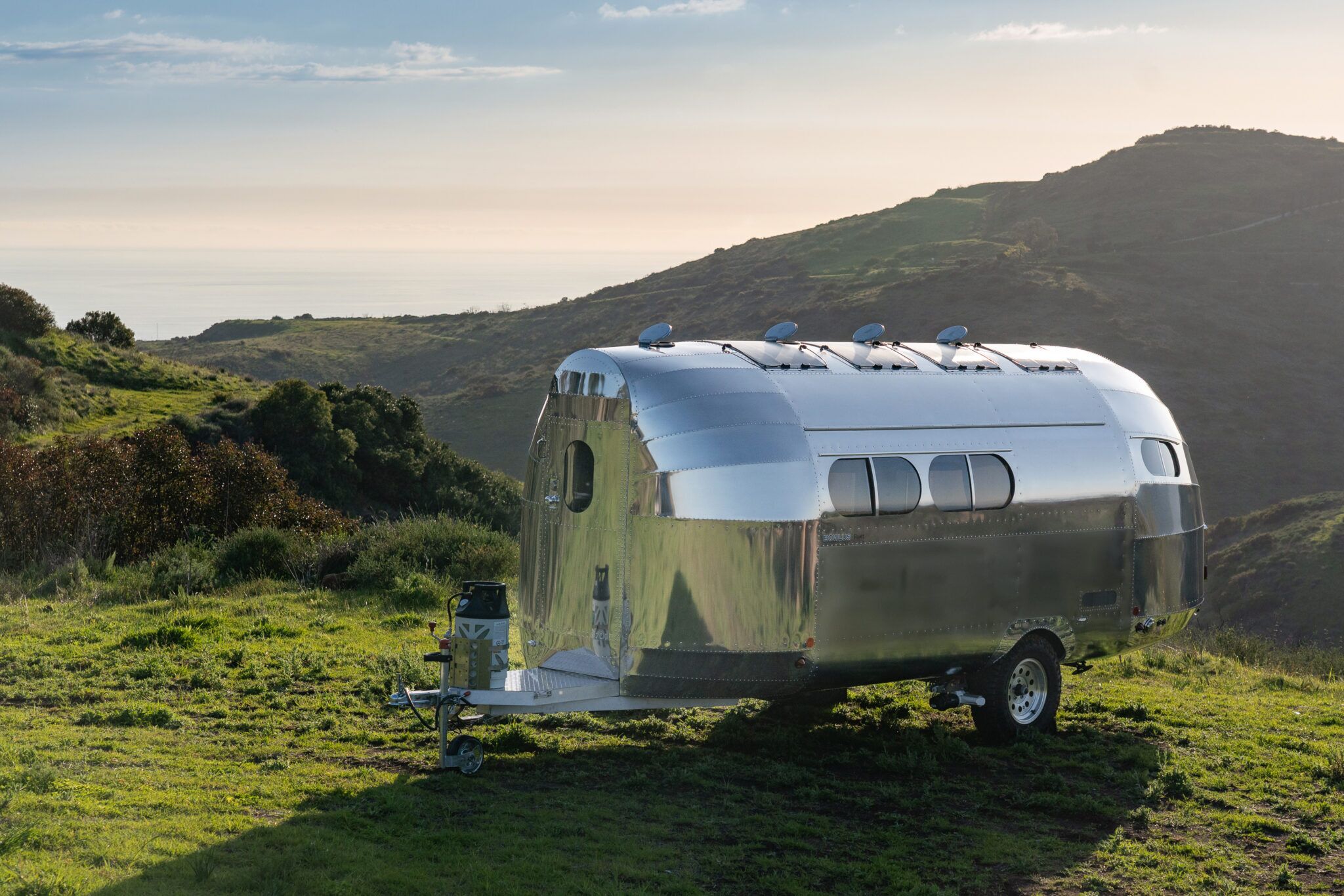
Finally, if money were no object, this would be the trailer I tow:

The Bowlus Rivet is an airplane fuselage disguised as a trailer. Our European host made us take off our shoes to walk inside the thing. Once inside we learned that while it has actually fewer amenities than trailers in its $150k price category ( you read that right) it is stupid lightweight for its size. That’s what you’re actually paying for. Sure the shower is clever, the other features are spare but well laid out, and thing outside is mirror-shiny, but what makes it worth it is the #2800 base weight. You can tow it with an SUV.

We would tow it with a cargo van – money being no object – for UnObtanium events. But we are not anywhere close to that kind of money.

Even so, it was fun to get out of the heat and daydream.

The Bajada Trail – main

A bajada is the mound of run-off sediment skirting the edge of the mountain. It is not quite Spanish for “Alluvial Fan”, but they are functionally the same thing.

The Bajada Trail winds up and across its namesake across the San Juan Valley in the Phoenix South Mountain preserve. Or, rather, the main western portion des this. The eastern third of the trail is basically a connector trail we have written about elsewhere.

The portion we write about here connects the San Juan Bicycle Center with the San Juan Lookout, running from its junction with the Max Delta Trail (at the lot) to its’ junction with the National Trail on the west end of the park. You then follow the National Trail northwest to the lookout.

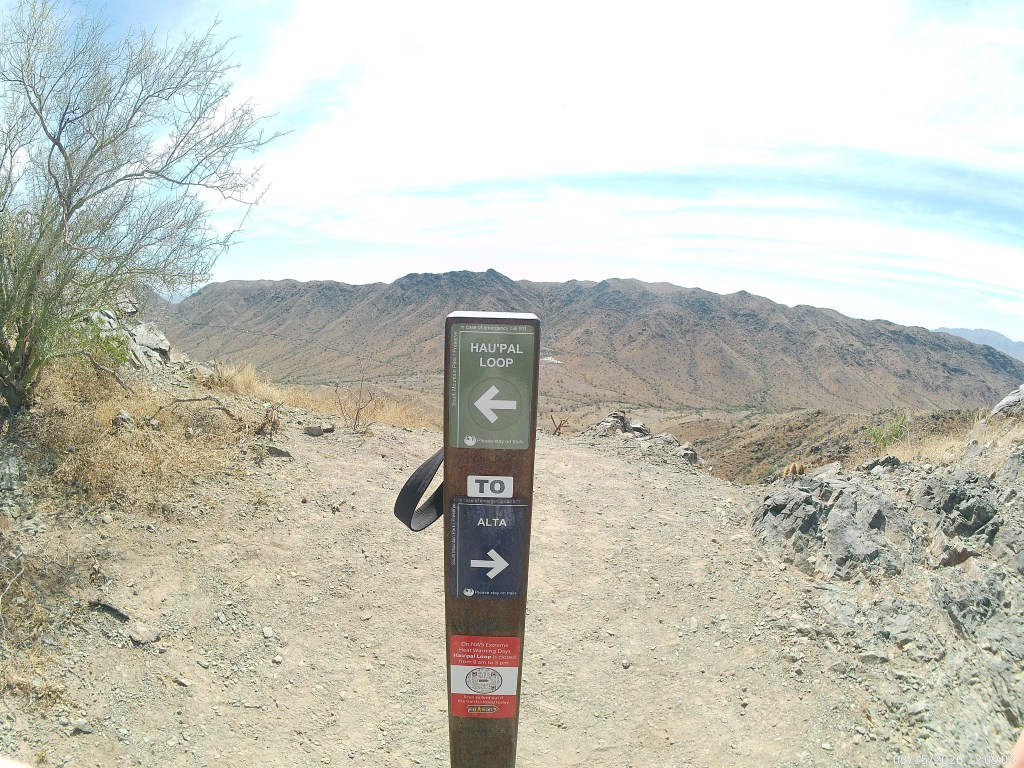
This is often done as a loop hike with the Alta Trail. If so, regardless of direction, do Alta is the harder of the two, and I always recommend doing the hard part first. If you do it as a loop, take a lunch.

I did this as a car shuttle. My plan was to park at the bike lot, and then have a friend drive me to the Curtis Saddle Trailhead. However, we lucked into one of those Brigadoon-like morning when the vehicle road to San Juan Lookout was actually open to actual vehicles. So, he dropped me off there instead.

The route is National Trail of Bajada Trail to the bike center – a route that is about 4.3 miles one way. Most people can do it in a couple of hours.

National Trail heading out from the lookout is what you picture single-track trail through the low desert to look like: Packed dirt wide enough for one pedestrian, winding through the cactus. There are not a lot of landmarks. Sure, to the west, AZ 202 crosses in front of the casino, but the trail itself has few features. The junction with the Maw Ha Tuak Perimeter Trail. A stand of teddy-bear cholla. A stand of chain fruit cholla. A stand with both of them together. A geologic marker. You cross three small washes, then a big one, and then East San Juan Road. On the far (south) side of that you come to the junction with the western terminus of the Bajada Trail. 

The National Trail, also called the Maricopa Trail heads off further southwest until it turns east and charges up the main Gila Range to the top ridge. It will continue east across that ridge to the other end of the park.

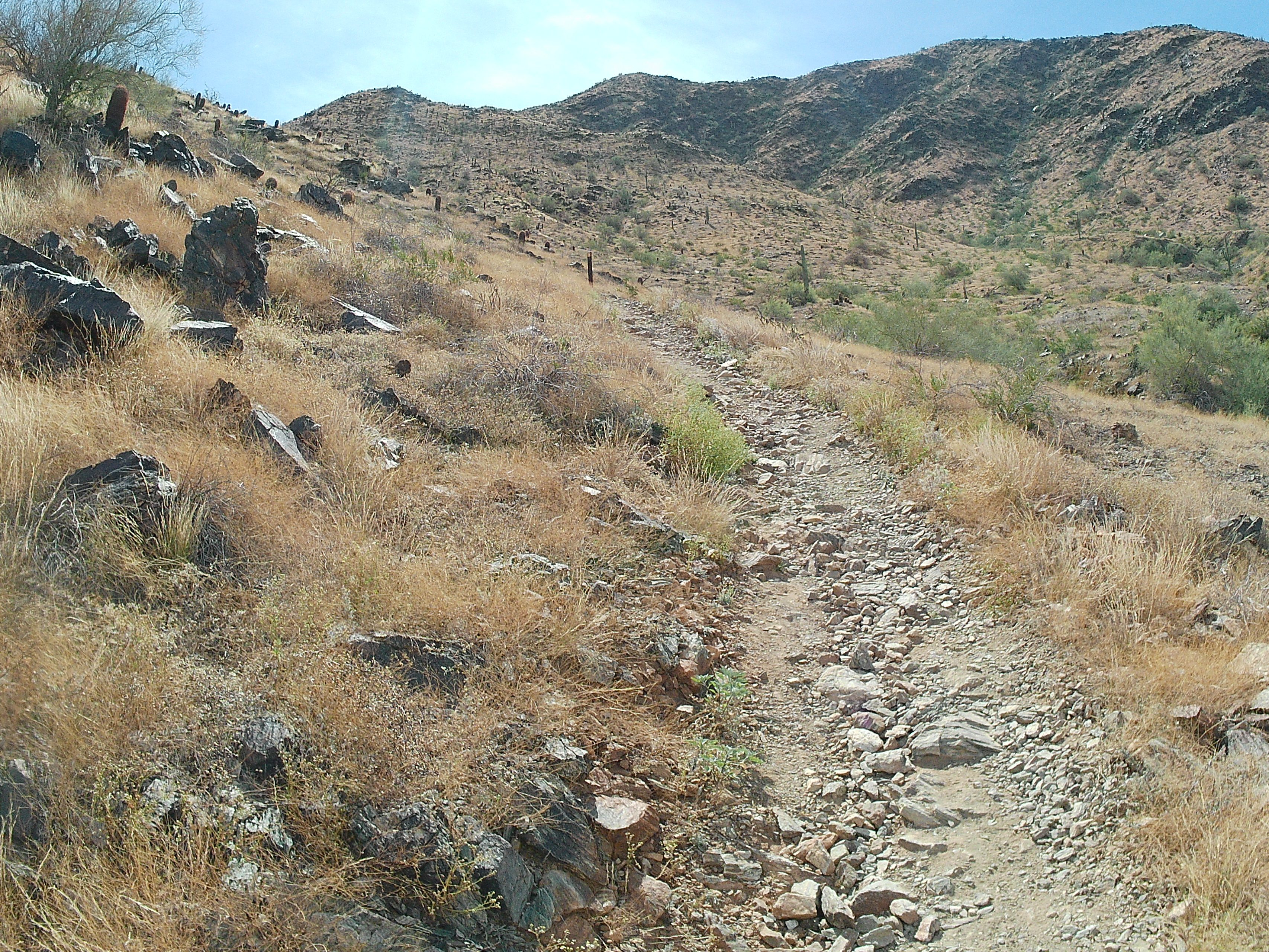
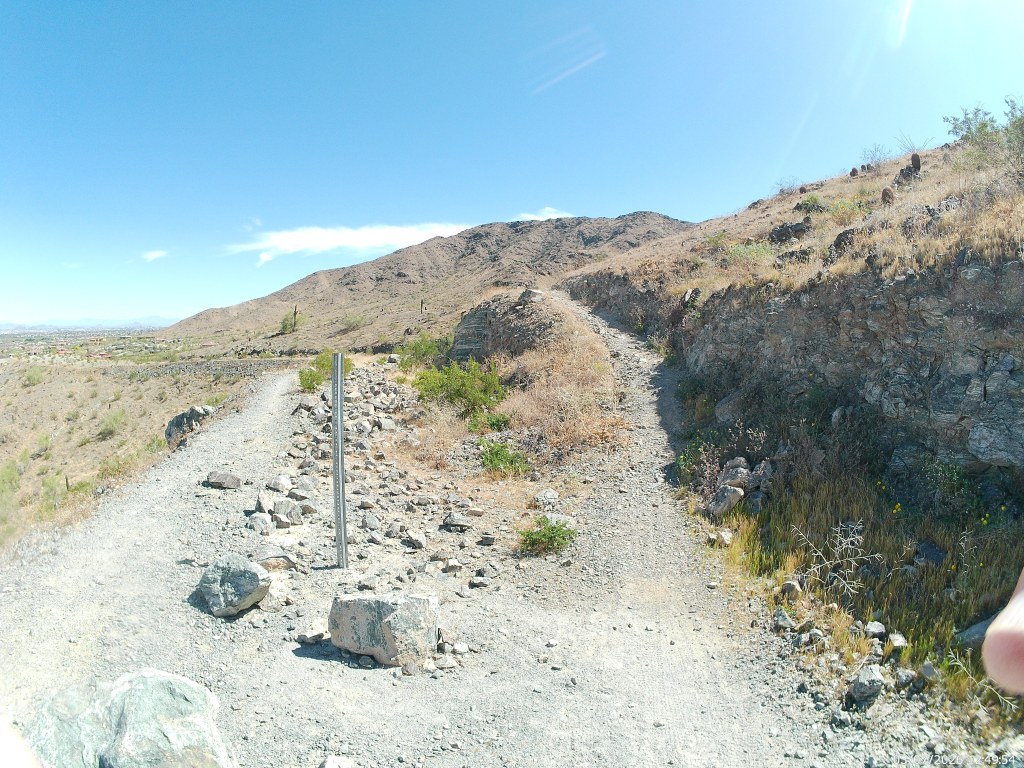
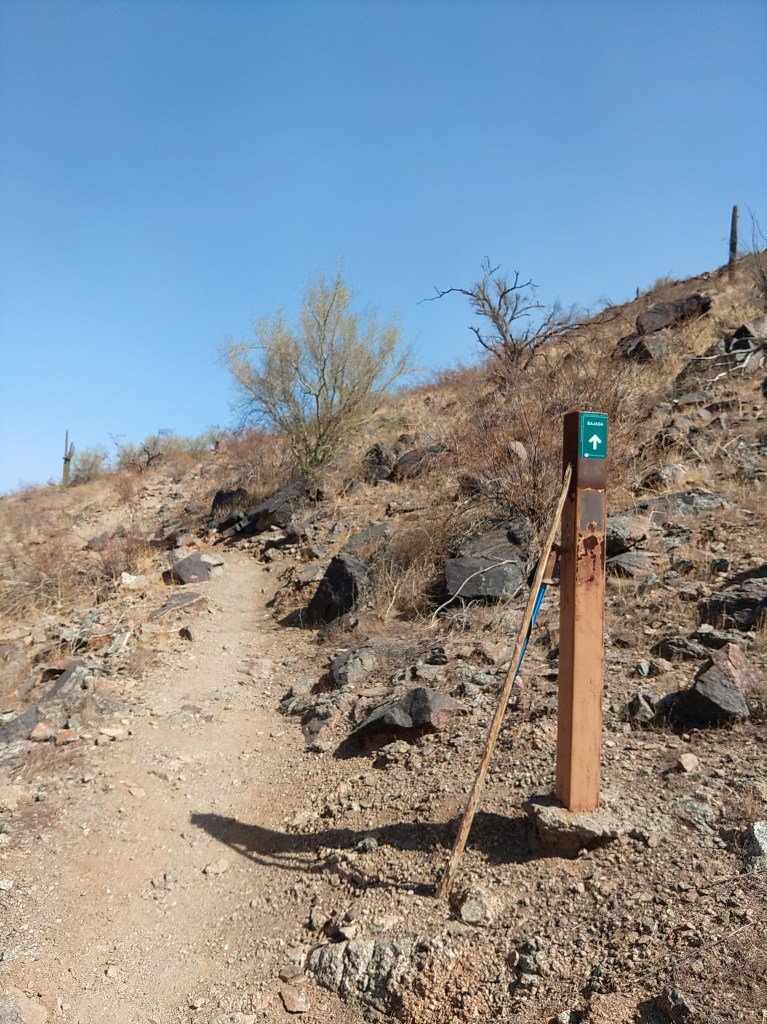
I took the Bajada Trail, of course. It promptly crossed the grey-gravel expanse of the main San Juan wash, and then began a lesser climb up the mountain, turning east kinda-sorta along the top of the bajada.

When the road is closed, and you get some distance from the freeway, this is one of the quietest sections in the park.

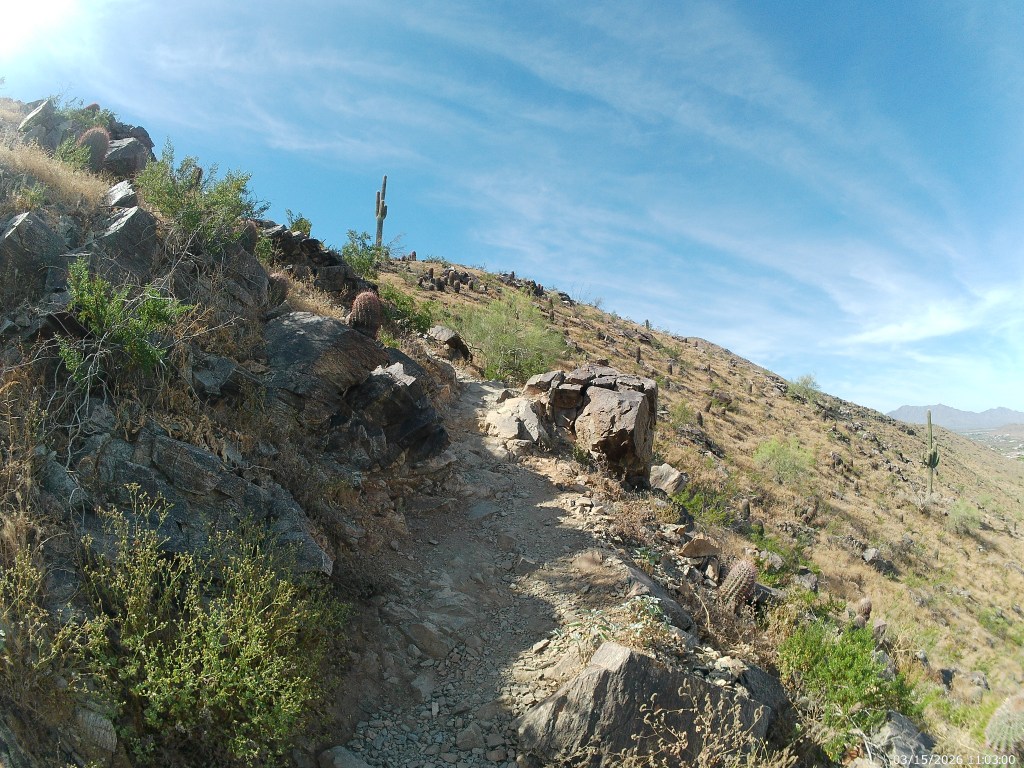
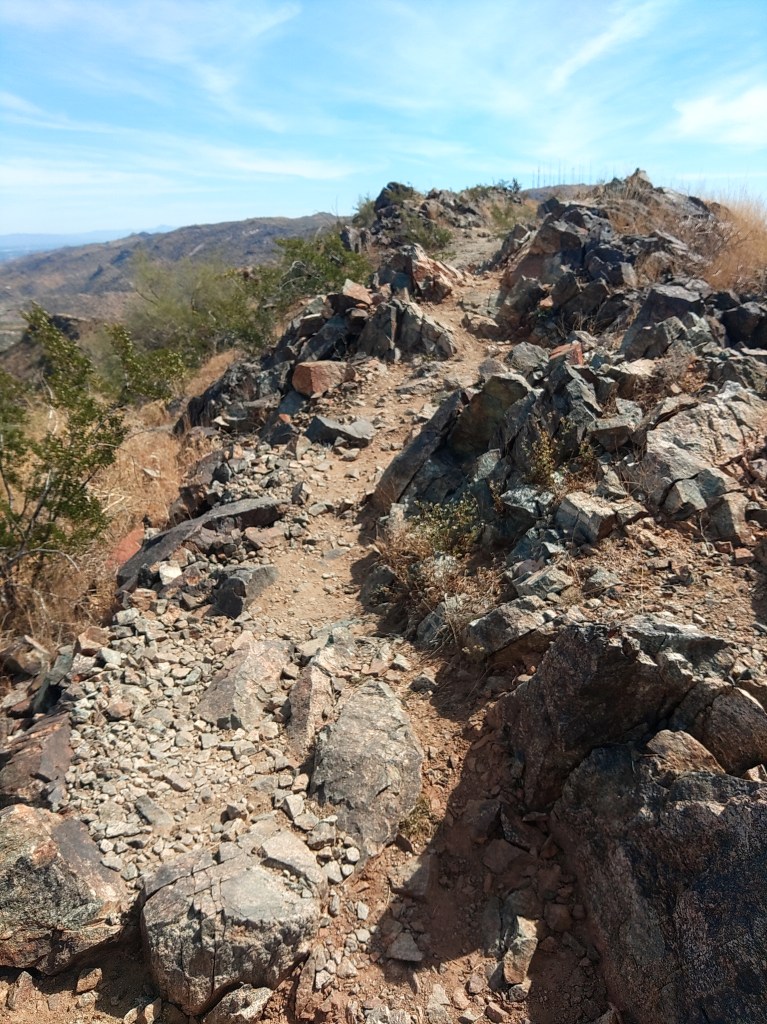
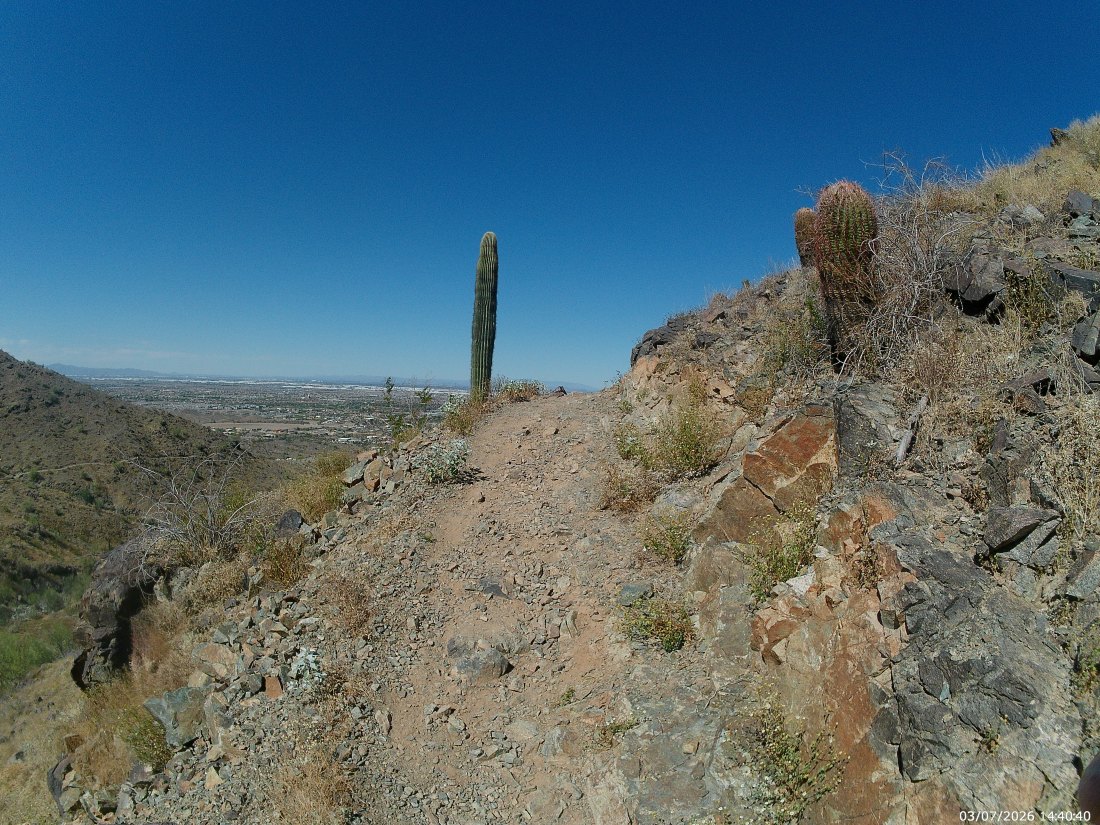
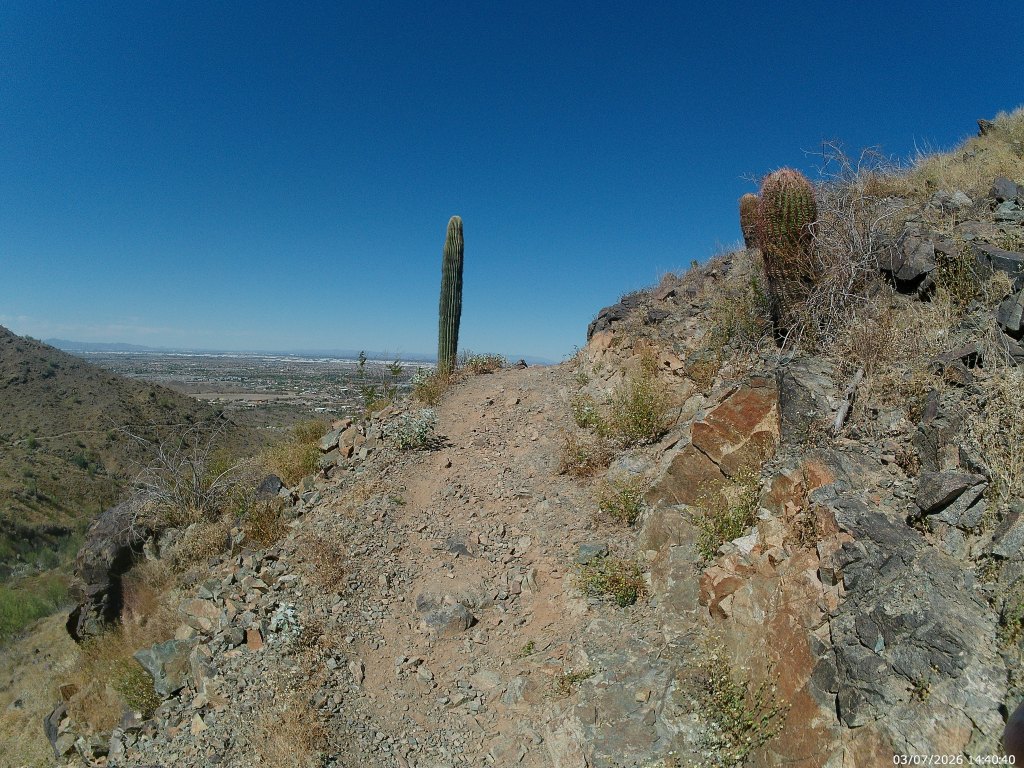
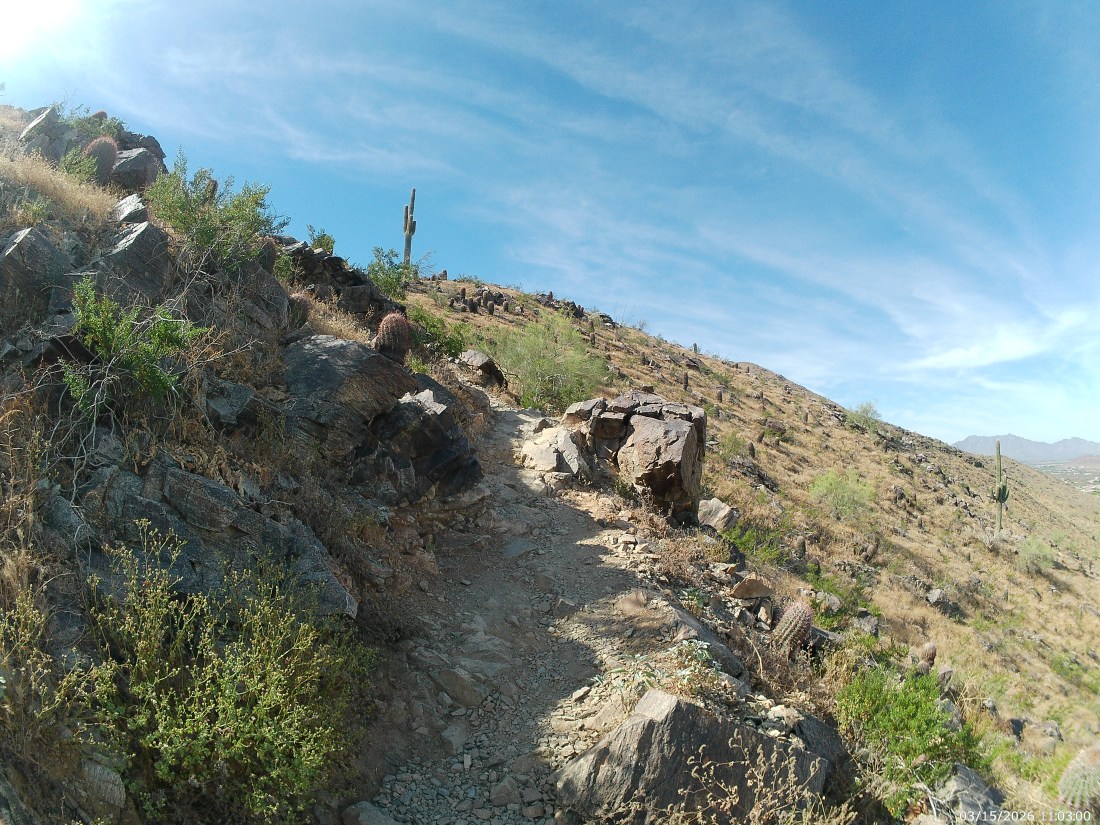
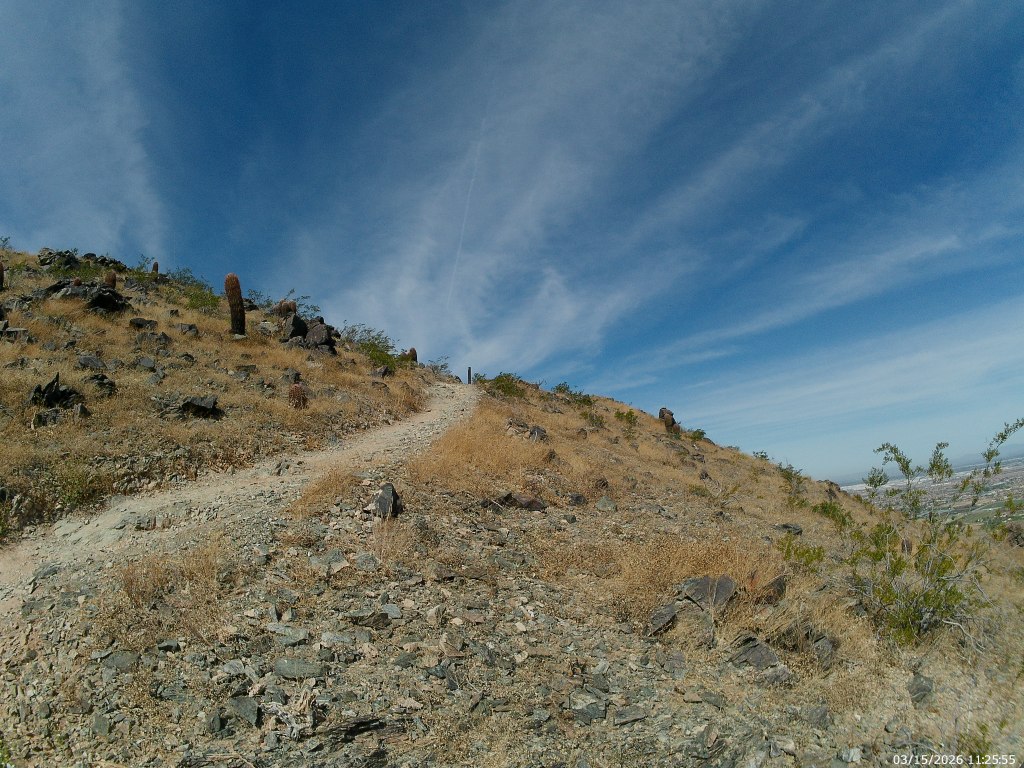
The trail will go up the berm and down the wash and up the berm for most of its remaining length (either direction). It is in excellent shape, a little rocky in places, blue and black basalt with a little gypsum for color, but you can do this in tennis shoes.  The entire length is a shadeless march through stunted palo-verde trees, bone dry creosote and a scattering of cacti.

The terrain is not your problem. Like all hikes in this park, or this area, do not attempt this in summer unless you start marching in the predawn gloom. The entire hike I noted two places (both washes) with enough shade that a grown human could sit down within.

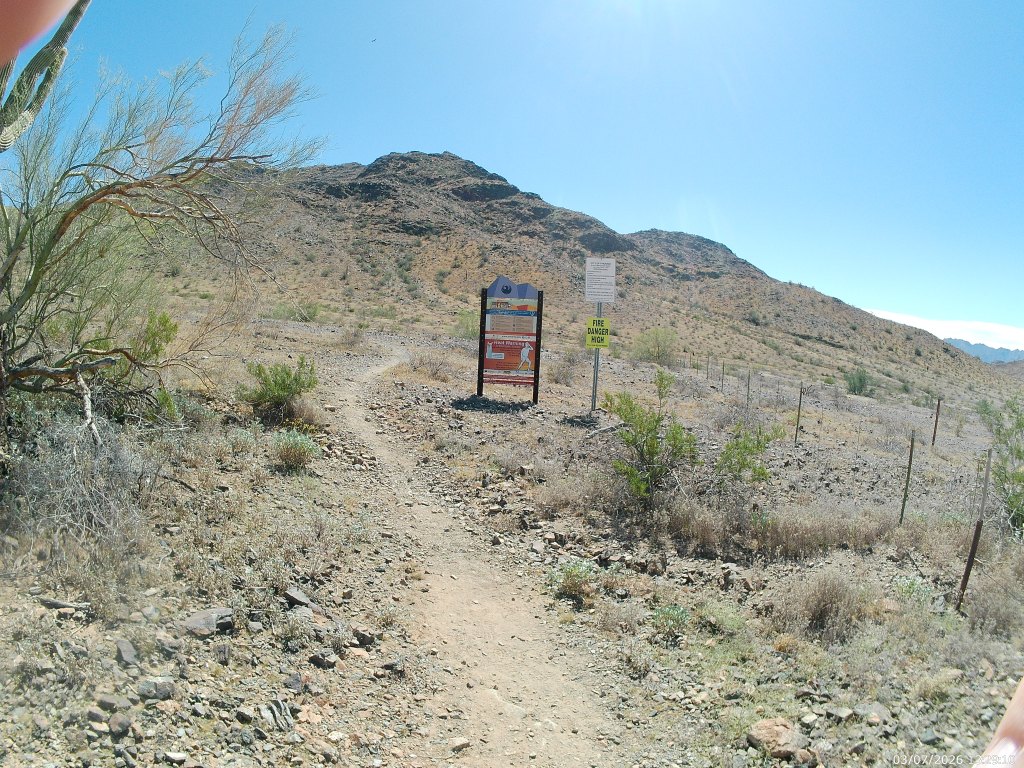
Below you (north) East San Juan Road follows the wash through the relatively quiet canyon. Towards the end, after one of the few sustained climbs, the trail with turn north and descend towards the road. Before you get there, as you start to enter the main wash, you will reach the junction with Alta Trail.

You are a half-mile from the trailhead. You can guzzle some water now.

Don’t cross the wash. Stay on Bajada as it turns east again, though and then out of the wash. Then across the desert floor a little farther to pavement.

If you look up the hill during this passage you will see mine trailings, and perhaps some social trails going up towards same. There is at least one open mine shaft still existing on those slopes, but you are on your own with that. When crawling about in mine-shafts, you are betting your life on the engineering acumen and diligence of whatever miner dug this 100+ years ago, and I cannot recommend that.

The bike lot has trashcans, but no other services. The San Juan Lookout has nothing but an old ramada and signage.

Pond to pond across Marshall Lake

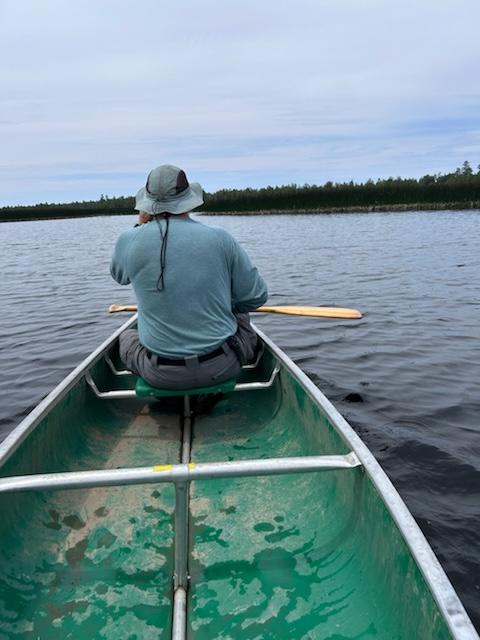
Photo by Ben Padegimas. Yes, that’s me.

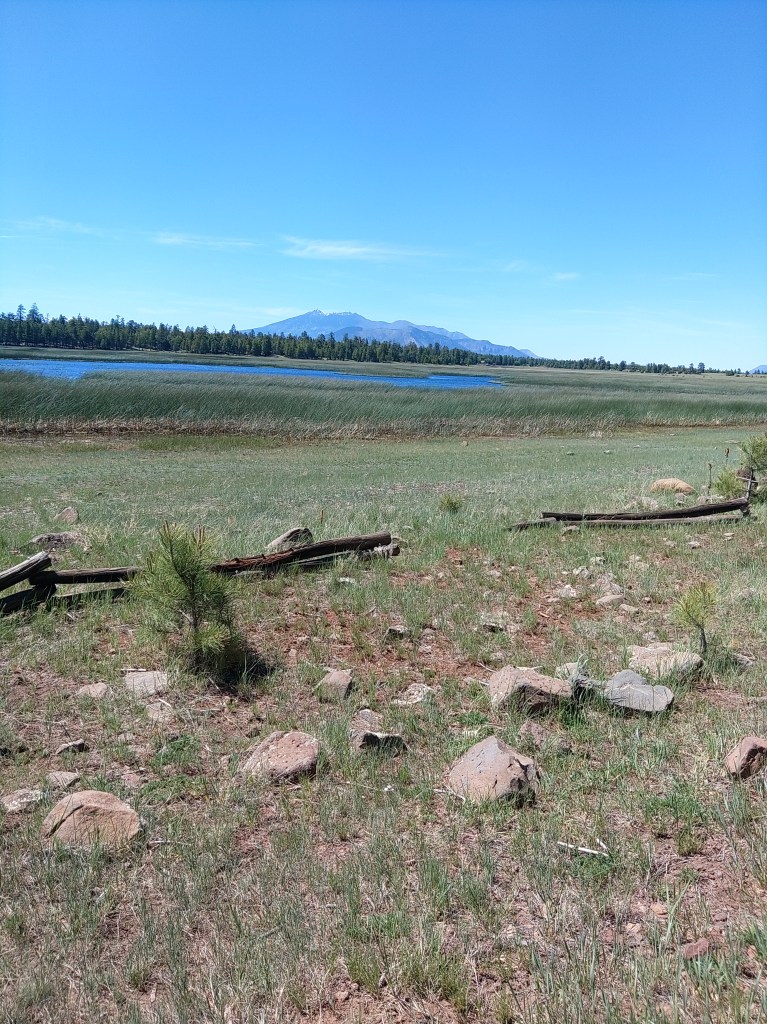
Marshall Lake is a small, marshy pond, really, just south of Flagstaff. Its’ reedy shores are full of birds, and the forested hills around it are full of dispersed campers.

Arizona does not have many natural lakes, but Marshall Lake is one of them. It’s really only a lake at its rare high water mark. At normal levels it is a series of connected ponds. There are times when it is completely dry.

On my last visit, my son and I were able to paddle a canoe through breaks in the reeds and go from pond to pond to see the birds and hear the frogs and waver to the scattered fisherfolk. At high levels, AZ Game and Fish will stock some trout in here. Folks have also caught channel catfish, northern pike, crappie and the occasional largemouth bass.

More numerous than fisherfolk are the ducks and coots. The Coconino National Forest slipped a good line past the fedbots:

“Marshall Lake is a small marshy body of water that’s generally full of coots and other waterfowl splashing, flapping, and cooting around. It is such valuable wildlife habitat that it is managed in partnership by Ducks Unlimited and the Arizona Game and Fish Department.”

Signs and portents by the lake.

You can also see osprey and even eagles around the lake. The hills around are popular for elk and are grazing allotments for cattle.

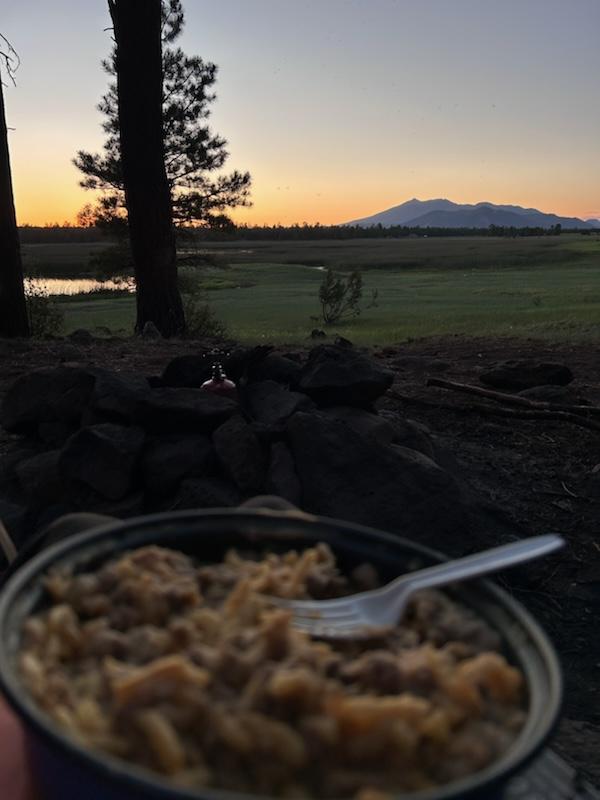
Dispersed camping means no services: no tables, no trash, no outhouses, no water. When we were there in late June, we were under a fire restriction, which covers all of these sites. Even so, the area is popular. If you aren’t up there by mid-morning Saturday on a weekend with good weather, you are likely camping somewhere else. A lot of your neighbors are clearly going to use all 14 days of the stay limit.

Photo by Ben Padegimas

Marshall Lake is seasonal, approximately May-October. Outside that window, the roads might close indefinitely due to snow.

The lake is located about 12 miles south of Flagstaff, off of lake Mary Road (aka FR3). Take that road south past the Lake Mary recreation sites to FR 128 which switchbacks up the hill before becoming graded dirt. Follow the signs.

There are no fees. There is a small parking lot next to the “boat launch”.

The observatory on the top of Anderson Mesa is not open to the public. The nearby trailhead is, and I have written about that in my book: 5 Star Hikes Sedona and Flagstaff.

There is a plan to improve the wetland conditions here, somehow. More information can be found here:

We quote from their 2013 PDF:

Current Status: The wetland is a perched clay basin with limited inflow from rain and snowmelt. As a result, Marshall Lake is sensitive to drought and is dry in many years. AGFD is conducting a water balance and feasibility assessment for habitat improvements in the Marshall Lake watershed. A restoration plan will be developed in coordination with the Coconino National Forest in 2015.

And finally, a video:

Max Delta Trail

Max Delta is an entry level trail through the entrance of the preserve. It is named after the mine shaft that lies buried and officially off limits towards its southern terminus. That is another article. This is just about the trail.

This trail is part of the Infrastructure Vista Loop Hike.

From the trailhead at the entrance (across from Scorpion Gulch) the flat, wide trail winds west then south, narrowing as it climbs up the ridgeline it will follow for half its’ distance.  Your first landmark is a monument and plaque commemorating the city elders who re-designated the park into a Phoenix South Mountain Preserve.

If you’re new here, Phoenix was founded by developers who eventually become old and rich philanthropic preservationists determined to protect the precious desert from the new wave of developers. Somewhere in the 1970’s, 1973 – by the plaque, the old developers city elders started designating the “park” as a “preserve”.

Litigation followed. But here it is, still more -or-less preserved.

Heading south, the trail intersects with the interpretive trail behind the old visitor’s center. This is one of the last of the original CCC buildings that still sees actual use.  Looking out, you can easily see the new visitor center in the distance, and the work compound just across the street. The old administration building still has restrooms and water available to the public. The small ranger office and gift shop it once house have moved elsewhere.

The gunfire you hear from the far side of the ridge is not random. There is a gun range on the other side, both the private Phoenix Rod and Gun Club and the Phoenix Police training range.  These have been here since 1948, when these slopes were still a “park”. They expanded somewhat contentiously in the 1990s, closing the trailhead on the terminus of 7th Ave at Olney.

They are not supposed to shoot hikers, even accidentally, even hikers off the trail, but the party investigating will be the one most likely to have shot you, so stay on this side of the ridge.

Climbing down from the ridge you cross low hills with patches of barrel cacti, then saguaro then teddy-bear cholla. The trail goes down into a wash and Y’s on the far side. Max Delta proceeds south, to your right. To the left, the trail crossing the road is the Derby Trail aka Los Lomitas. You can take that turn and shave a good 40% off the loop hike. But for now, we follow the Max Delta.

The dirt turns grey as the trail crosses the arroyo, finally a bit away from the road.  You will cross another road, along with numerous washes, but it gives brief illusions of crossing open desert. Look for mine pits along the way.

The gates were closed at the San Juan Bike Hub, as this was not the first weekend of the month. It’s not closed to people, but certainly closed to vehicles. Even on the special weekend, it just affords closer parking to those who want to hike or bike down San Juan Road – which is another article.  There are some amphitheater seats which were not shaded in the afternoon by the large metal canopy, a trash receptacle, and a good number of empty parking spaces for both bikes and cars. I was the only person there when I arrived, and took a break there, surrounded by this rust-colored monument to municipal expenditure.

Then I proceeded east down the Bajada Trail to continue on with the loop.