Rediscovering the old Apache Trail

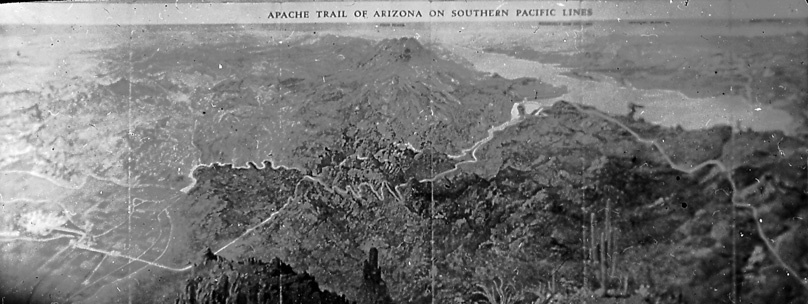
Photo taken circa 1910. Arizona State Library

The Apache Trail has re-opened, and one hot September 2024 Sunday, my son and I found ourselves with no obligations we could not avoid. Being too hot to hike (daytime highs never sank below 95 the entirety of September in 2024) (God – I hope that’s a remarkable sentence in the future) my son suggested that I should drive.

Because the AC in my 2015 Subaru still works.

Thus, we found ourselves burning down the Superstition Freeway [US60] past Chandler and Mesa and east Mesa and Gilbert all the way to Apache Junction where you finally exit and go north on Idaho Road.

In about two miles, Idaho road forms a triangle with the Old West Highway and state route 88, otherwise known as the Apache Trail.

The park his triangle forms around is the beating heart of the great, sprawling trailer park that is Apache junction. I kid – it’s not really one super-massive trailer park. It is a cluster of large trailer parks separated by small strip malls. Keep driving.

There are several side trips accessed from this road, and we will append those links at the bottom of the article as we document them.
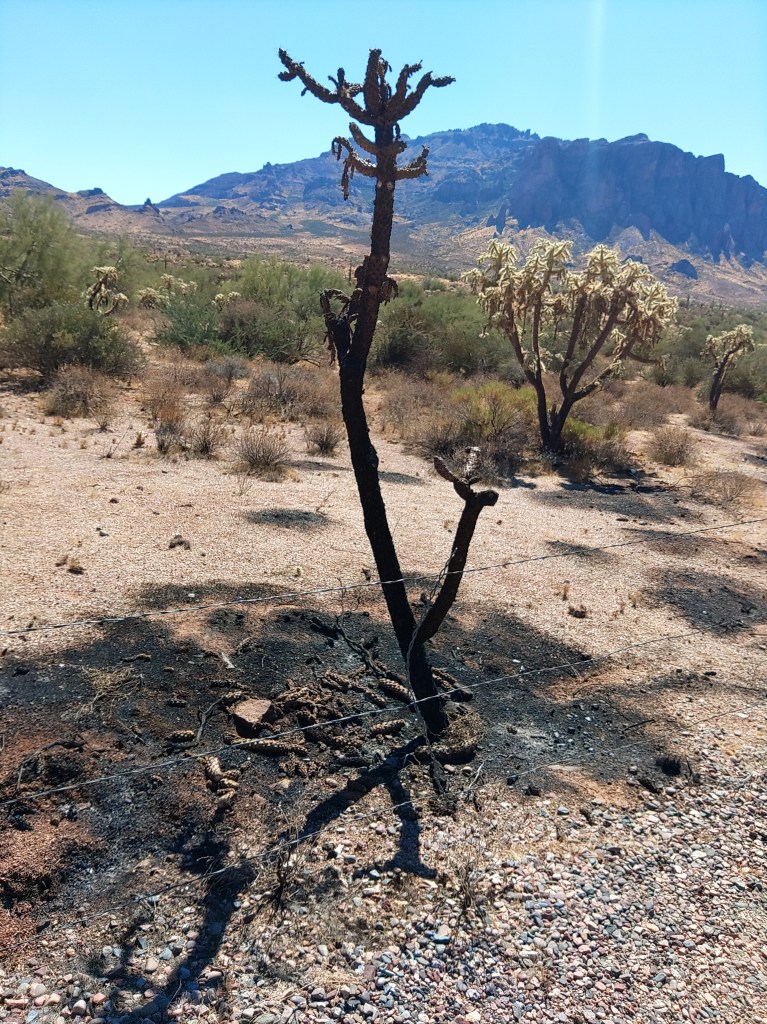
Apache Trail goes northeast, out of Apache Junction and along the edge of the Superstition Mountains – or increasingly, what is left of them.  For behold, once you pass the Lost Dutchman State Park and the Goldfield “ghost town”, you enter Tonto National Forest, and more tragically, burn scar country.

In June of 2019, the inevitable fire, called the Woodberry Fire, consumed almost 124,000 acres, much of it along this road. In September of that same year, monsoons dumped six inches of rain on the fresh fire scar and the resulting runoff damaged large portions of the road and left the stretch between Fish Creek Vista and Reavis trailhead impassable – for years.
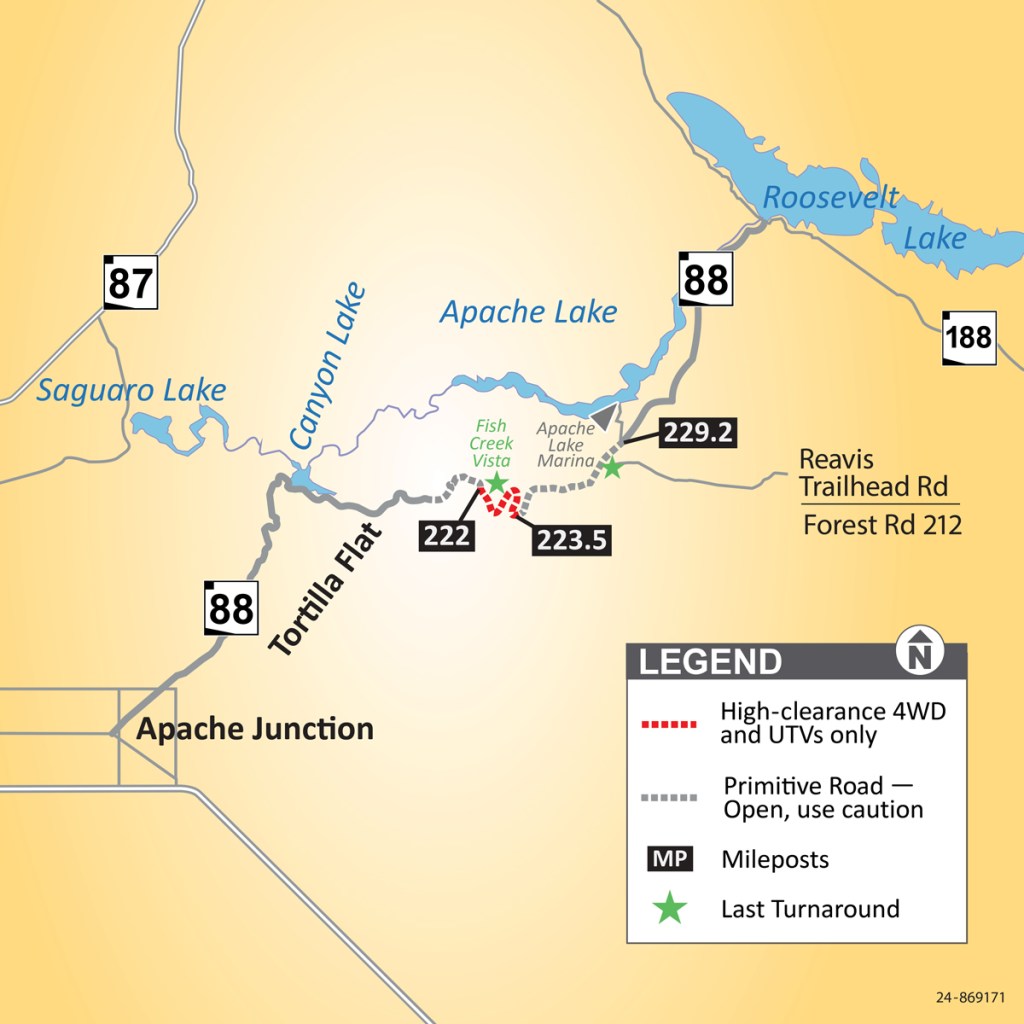
ADOT map of the fire damage closures. You can pretend the red line is grey now.

Road maintenance, you see, unfairly heightens the tax burden of the rich. No- that’s not it. I mean, a majority of the Arizona legislature has said things like that out loud, but the other problem is that the Apache Trail, when it was open, saw less than 300 vehicles a day.

The Apache Trail has never been a thoroughfare. The northern terminus is a T with AZ188 along the south shore of Roosevelt Lake. Heading northwest will eventually get you to Payson, but AZ87 is far easier. Heading southeast will get you to Globe, but even the winding, two-lanes-through-tunnels US60 will get you there faster – usually.

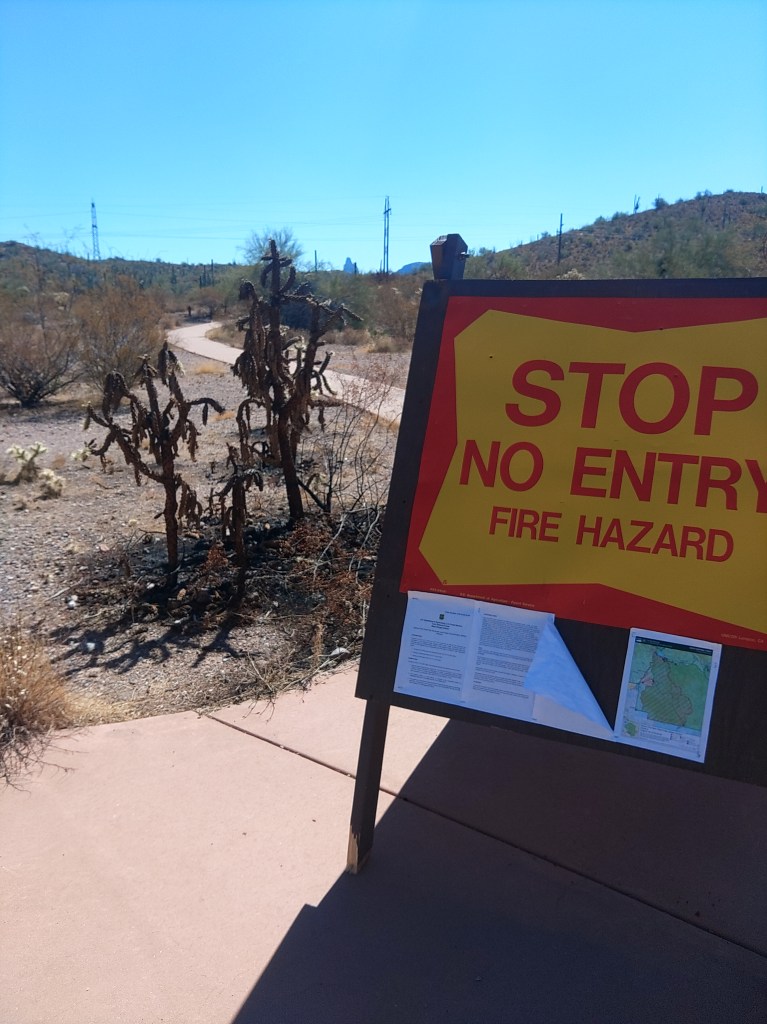
Trail construction circa 1909. US archives.

Apache trail was constructed, starting in 1903, as a supply road for what would become Roosevelt Dam. It gained its name from the large portion of the labor force that was Apache – including the ones who built the road.

For the most part, AZ88 follows the same route.

The southwestern trailheads into the Superstitions were still closed from fire damage as we drove past them. They may be for a long time.  Fire is not part of the life cycle of the Sonoran Desert. It takes decades to grow back to where ecologists would feel comfortable again.

The road is still paved as it turns east to skirt the shore of Canyon Lake, which like most lakes in Arizona, is actually a reservoir. Every lake I mention in this article is actually a reservoir. You will pass some day-use boating sites, the marina, and then head back up the hillside towards Tortilla Flat.

Tortilla Flat is a bar/hotel/gift shop complex. On this Sunday, it was packed with bikers, and we decided we could wait until we got to Globe to eat. Given the line outside the restaurant, we might eat sooner in Globe. Your results might vary.

The trail climbs here and on top of the ridge you will pass Fish Hill overlook, which is worth a moment to stop and stretch. And there are vault toilets if you need. A short trail goes to a concrete pad with some visibility of the Salt River Canyon below. But the trail beyond that is not technically closed, and you can follow it to a more distant rocky knob with better views.

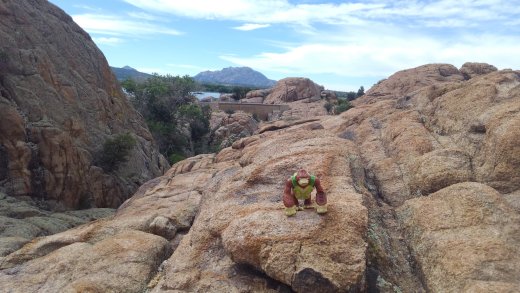
Panorama of Fish Hill Point (and Ben)

Past Fish Hill, you enter the recently opened heart of AZ88 as the road dips and winds in and out of Fish Creek Canyon crossing a couple of single-lane bridges.  There is nothing here that cannot be traversed in a passenger car, if you take your time and pay attention – which you will want to do anyway- right? That is the point of taking this route.

Over the ridge you pass a couple of scenic turnouts overlooking Apache Lake, and later Burnt Corral Campground. Past the campground, the road runs along the canyon wall, just above the Salt River, fat and lazy between dams until the biggest of the dams, Roosevelt, looms ahead.

At the time it was constructed, 1905-1911, Theodore Roosevelt Dam was the largest masonry dam in the world, built from stones carved out of this very canyon and held in place by cement mixed on site. A whole village was built to accommodate the workers as they built the place, called Roosevelt, of course, most of which would be submerged by the very dam its inhabitants built.
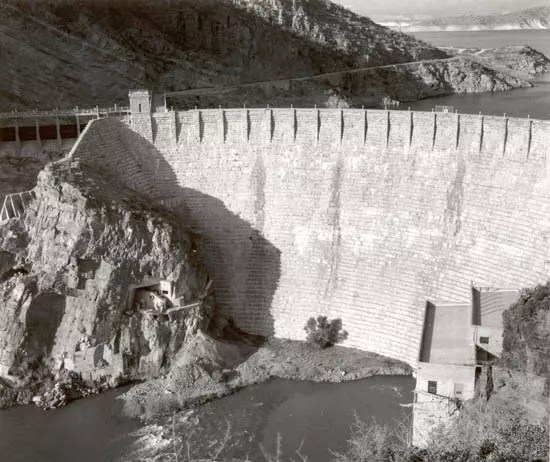
Roosevelt Dam – spanking new. USPS
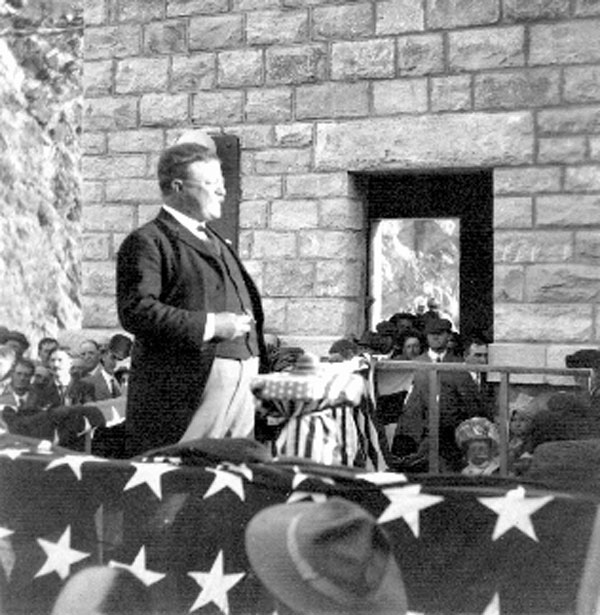
TR at the 1911 dedication. USPS.

One of the first projects of Roosevelt’s new Bureau of Reclamation, it was one of the first hydro-electric dams of any scale, and created what was, at the time, the largest artificial “lake” in the world.

That lake stretches out before you after you wind up past the dam and reach the T intersection with AZ188, which runs across the southern shores of that reservoir.  You will also pass plenty of pull-outs if you want photos of the dam.

This is Roosevelt Junction and the termination of AZ88. You are still a half-hour from Globe – so this was no shortcut. But still worth it.
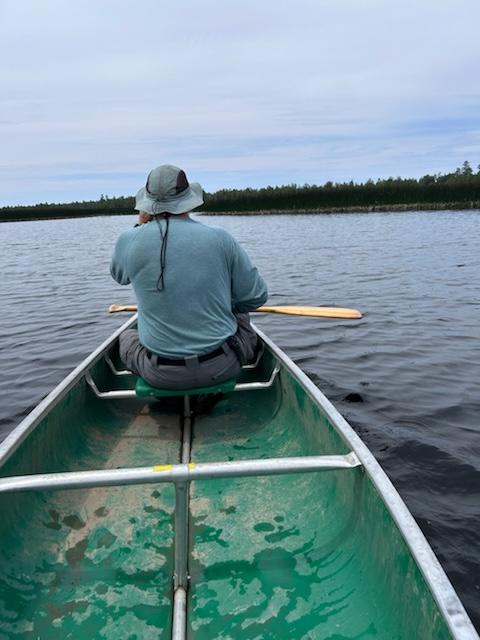
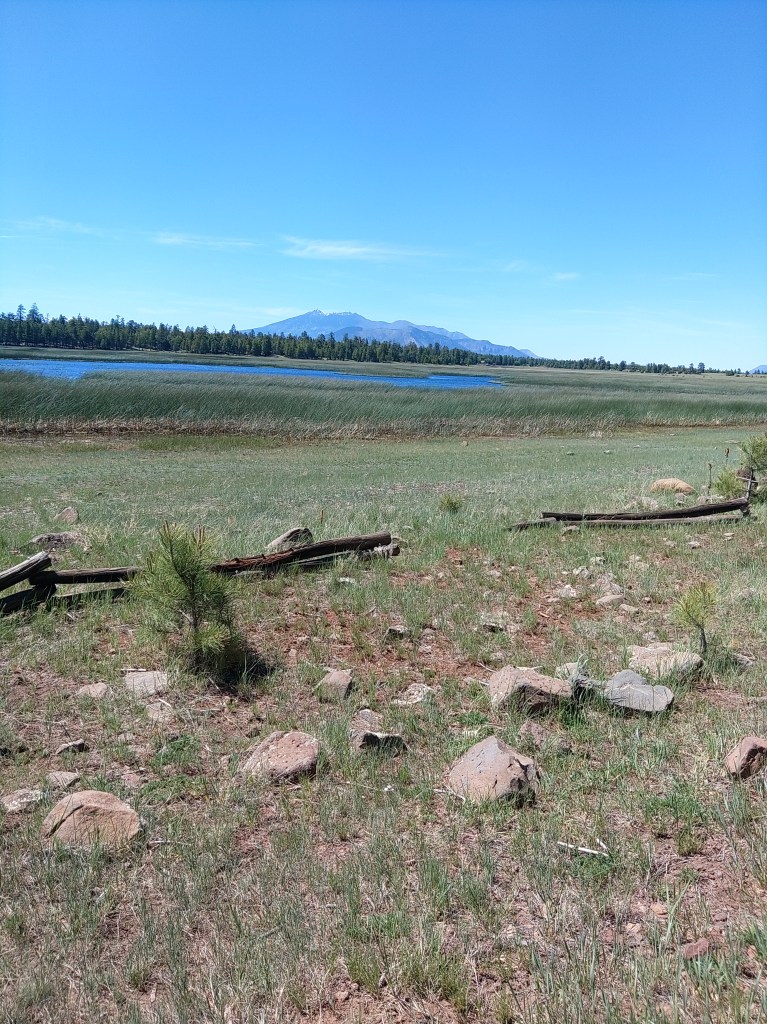
Pond to pond across Marshall Lake

Photo by Ben Padegimas. Yes, that’s me.

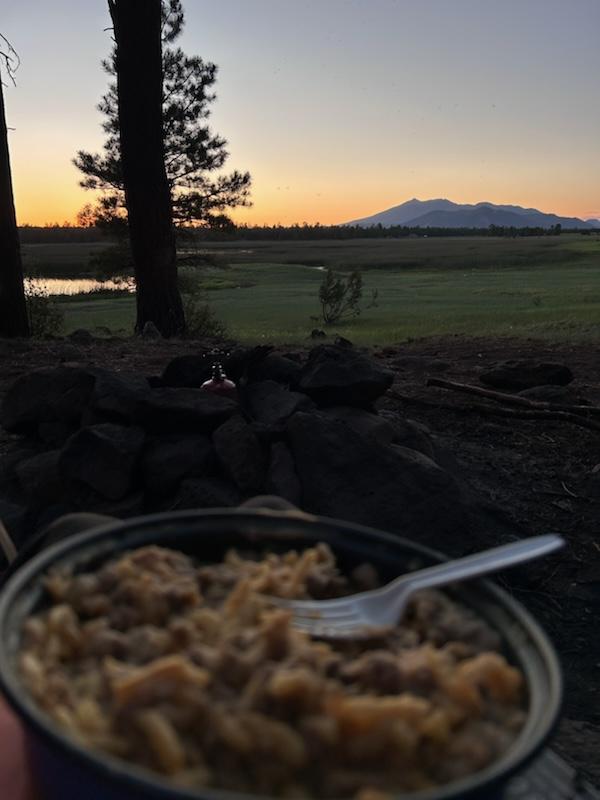
Marshall Lake is a small, marshy pond, really, just south of Flagstaff. Its’ reedy shores are full of birds, and the forested hills around it are full of dispersed campers.

Arizona does not have many natural lakes, but Marshall Lake is one of them. It’s really only a lake at its rare high water mark. At normal levels it is a series of connected ponds. There are times when it is completely dry.

On my last visit, my son and I were able to paddle a canoe through breaks in the reeds and go from pond to pond to see the birds and hear the frogs and waver to the scattered fisherfolk. At high levels, AZ Game and Fish will stock some trout in here. Folks have also caught channel catfish, northern pike, crappie and the occasional largemouth bass.

More numerous than fisherfolk are the ducks and coots. The Coconino National Forest slipped a good line past the fedbots:

“Marshall Lake is a small marshy body of water that’s generally full of coots and other waterfowl splashing, flapping, and cooting around. It is such valuable wildlife habitat that it is managed in partnership by Ducks Unlimited and the Arizona Game and Fish Department.”

Signs and portents by the lake.

You can also see osprey and even eagles around the lake. The hills around are popular for elk and are grazing allotments for cattle.

Dispersed camping means no services: no tables, no trash, no outhouses, no water. When we were there in late June, we were under a fire restriction, which covers all of these sites. Even so, the area is popular. If you aren’t up there by mid-morning Saturday on a weekend with good weather, you are likely camping somewhere else. A lot of your neighbors are clearly going to use all 14 days of the stay limit.

Photo by Ben Padegimas

Marshall Lake is seasonal, approximately May-October. Outside that window, the roads might close indefinitely due to snow.

The lake is located about 12 miles south of Flagstaff, off of lake Mary Road (aka FR3). Take that road south past the Lake Mary recreation sites to FR 128 which switchbacks up the hill before becoming graded dirt. Follow the signs.

There are no fees. There is a small parking lot next to the “boat launch”.

The observatory on the top of Anderson Mesa is not open to the public. The nearby trailhead is, and I have written about that in my book: 5 Star Hikes Sedona and Flagstaff.

There is a plan to improve the wetland conditions here, somehow. More information can be found here:

We quote from their 2013 PDF:

Current Status: The wetland is a perched clay basin with limited inflow from rain and snowmelt. As a result, Marshall Lake is sensitive to drought and is dry in many years. AGFD is conducting a water balance and feasibility assessment for habitat improvements in the Marshall Lake watershed. A restoration plan will be developed in coordination with the Coconino National Forest in 2015.

And finally, a video:

The water works of Tres Rios

Photo from city of phoenix website

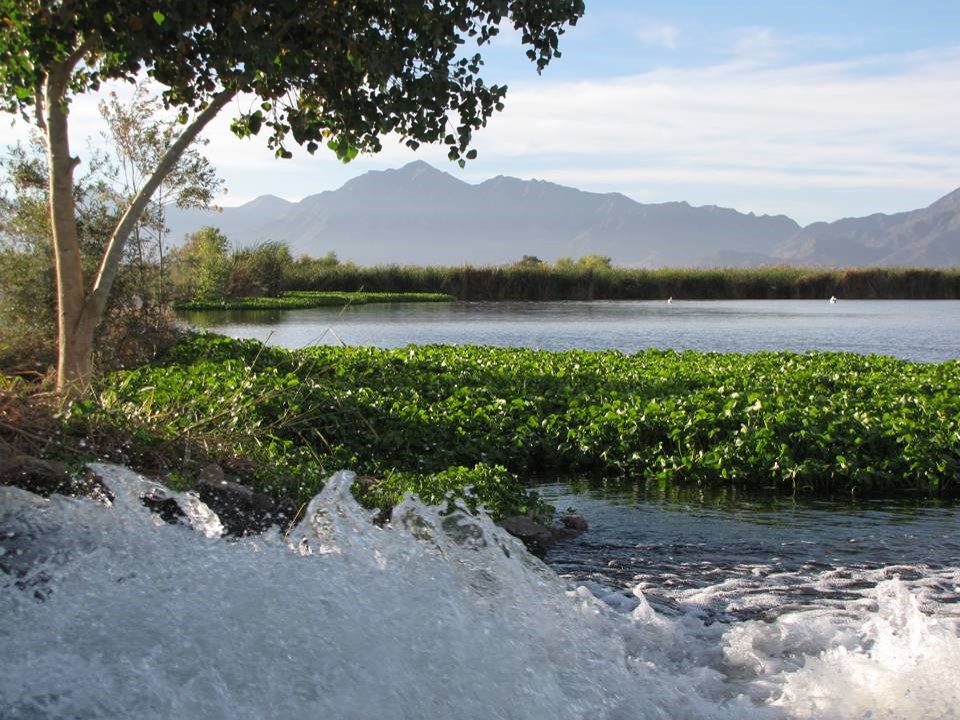
Tres Rios Wetlands Environmental Restoration Project is the outflow from the city of Phoenix water treatment facility that they have made into a public park. No – the water’s fine. It’s already treated before you can get anywhere near it. They won’t let you swim in it, but they will let you walk around (with a free permit) and fish (with a paid permit).

One path through here is a segment of both the Sun Circle Trail, a bike route that runs around most of the cities in the metro area and the Maricopa trail, which circumnavigates the entire metro area. [They have an interactive map!} Also, it is a local hike, and the day (30 Jan 2022) was great for local hiking.

My route would start at Tres Rios, then follow the trail past it, westwards along the Salt Riverbed to its confluence with the Gila river, near the Base and Meridian Wildlife Area. I would return the way I came.

Tres Rios has a gravel parking area, a single plastic outhouse, interpretive signage and large trashcans. There are no other services.  The large trashcans represent a futile attempt to keep fisherfolk from leaving their fishing garbage all over their fishing place.

The city says this of the project:

The lush and scenic Tres Rios is now home to more than 150 different species of birds and animals like muskrats, raccoons, skunks, coyotes, bobcats, and beavers. The beautiful cottonwood groves, willows, mesquites, and other desert shrubs around the reed-lined ponds and along the trail attract many migratory and wintering songbirds. By bringing the Salt River back to the condition it was in during the early 1800s, this project is repairing a natural habitat. 

The reclaimed water from the wastewater treatment plant is pumped over to the wetlands, and the plants and animals take what they need before it is discharged back into the river.

Like the 1800’s only now, and with more plastic trash

From the parking lot, three trails (wide graded dirt roads really) proceed westward in parallel. The center one, with the signs, if the official course of the Maricopa Trail. It also seemed the most crowded in the late morning, but also had the better of what scenery there was. To the north are the lagoons, and to the left, after the first half mile, is the mesquite bosque. The trail also passes the “waterfall” where the lagoons discharge into the Salt Riverbed.

The north track has those same lagoons to its south, and open farm fields to its north.

The south track had brush to the north and the normally dry portion of the Salt River to the south. It also features zero shade.

I had dutifully applied for my permit, and had it ready to show on my phone, but there was no evidence that anyone enforces that. All the numerous “No Trespassing” signs about the place – that means people without permits.  Or visiting after dark- park hours are dusk/dawn.

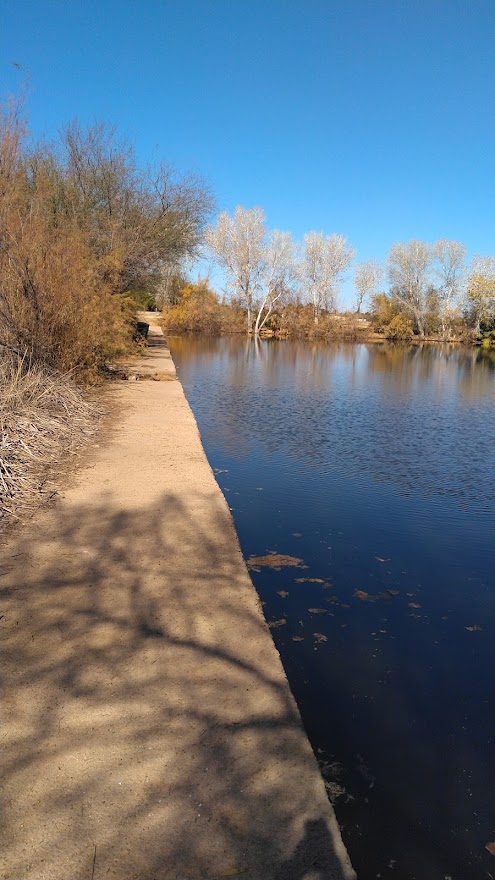
Several concrete causeways separate the various lagoons, and these can be crossed on foot. I’m not sure if you are supposed to, but fisherfolk clearly do this all the time. But beware, At least two spillways on each causeway guarantee a water hazard.

Past the lagoons, the north and center roads converge, ending in a turn-around marked by giant concrete pipes. To the north of these pipes, the Maricopa trail continues, intermittently following the remnant rod, or making its way as a dedicated footpath.

I dutifully followed the marked trail on my way in as it hugged the great wall of caged rock that marks the northern edge of the Salt’s flood-zone. I followed a series of dirt roads on my way back and found that I did not miss the trail at all.

The trail closes in on the riverbank just as you reach the boundaries of Base and Meridian Wildlife Area. B&M is primarily a fishing spot. It shares parking with the Phoenix International Raceway. From that parking lot, a bridge crosses a wash to land onto a paved road bisecting the riverbed. From this road all manner of dirt roads and trails fan out to various fishing spots.

Due south of the parking lot is monument hill, where the geo-marker forming the basis for the state’s survey lines is located. Alas, it is also possible to glimpse into the raceway from that height, so the hill is now fenced off. It’s not much of a fence, but you would be on your own with that. I tossed the garbage I had collected on the trail into the trashcans provided at the trailhead and turned back.

I found the actual confluence, where the Gila, maybe ten feet across at that point, burbles into the Salt, fattened to hundreds of yards across by the Tres Rios discharge.

One of the dirt roads bisects an island in the middle of what would not be the Gila River, and I was able to sit quietly on the bank and listen to one fisherfolks Tejano music battle with another’s rap music battle with oldie-rock being covered by whatever band was playing whatever even went on at the raceway.

Remember that you are, at either trailhead, walking distance from a convenience store. This will not be a wilderness experience.

Even so, I did find some measure of peace and quiet. On my return, following the dirt roads closer to the river, I encountered nobody for the better part of a mile, and was able to even sit by the river in peaceful reflection, doctoring a blister. That moment alone kinda made the trip worth it.

I did not bother to GPS this, but ten miles round trip feels right. You could probably do it in eight miles if you did not wander. I was on the trail about five hours.

Ten seconds of water in the desert

Backpacking in Point Reyes National Seashore

KIMG0669
Bongo at Bear Valley Trailhead

In April of 2018 I scored a permit to camp inside the Point Reyes National Seashore just north of San Francisco. There are no drive-in campsites in Point Reyes; they are all walk-in or boat in. In the case of the Glen Campground, where I had a ($20) permit, this meant about 5 miles from the visitor center.

Just long enough to call it backpacking.

The Bear Canyon Visitor Center is everyone’s first stop, being where the permits come from, and correspondingly crowded. Get beyond it, and the little maze of day-use trails wandering around the picnic grounds, and the crowds started to thin, even on a Sunday afternoon with good weather.

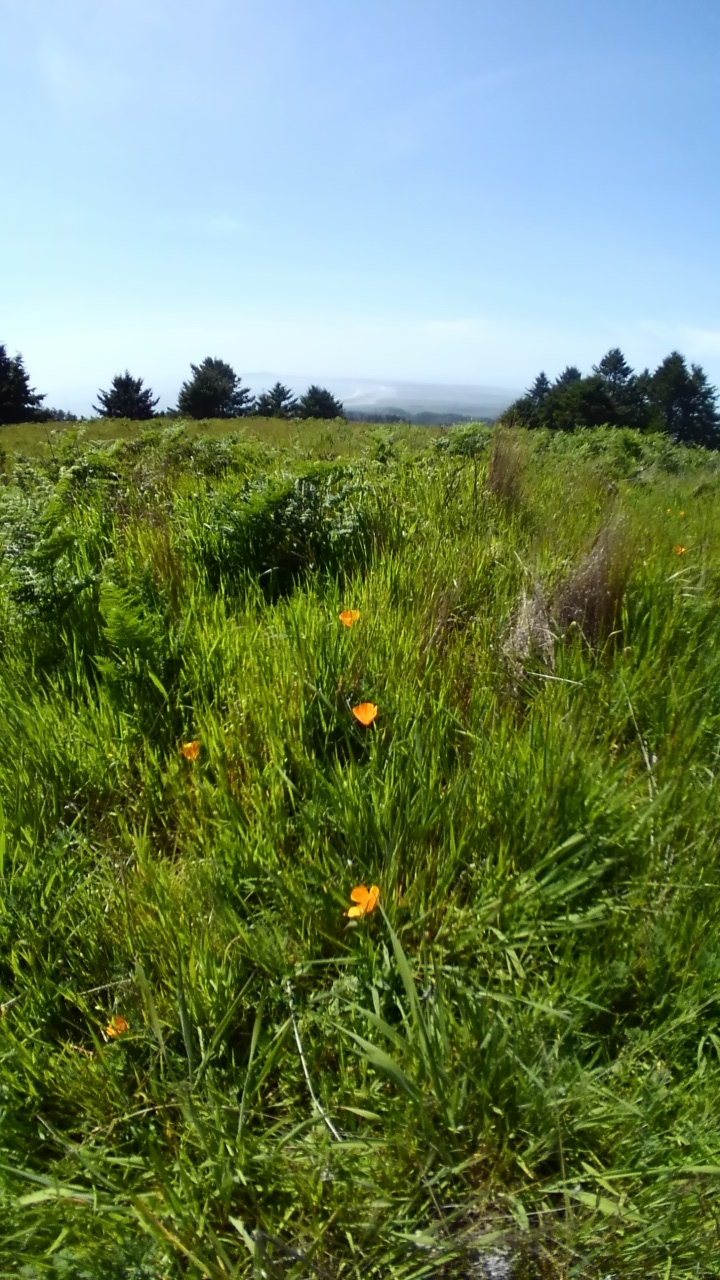
I headed south(ish) along the Bear Valley trail until I realized this dirt road is everyone’s day hike. So I cut to the right, west, up the Meadow Trail. This spur trail cuts steeply uphill to the Skyline Trail, which bisects the main ridge forming the peninsula.

KIMG0666.JPG
Pretty typical…

The heart of Point Reyes is Inverness Ridge, which has been separated from Bolinas Ridge on the coast be the San Andreas fault. To the north end of the peninsula, that fault line is submerged by Tomales Bay. To the south it runs roughly under Highway 1. Point Reyes is a couple notches of Richter Scale away from being an island.

The thick canopy of trees and brush are all part of the Phillip Burton Wilderness, which actually encompasses about a third of the total peninsula. The rest is extant private ranches and a scattering of state and local parks.

It felt strange climbing the hill, until I realized that I was still at about 700’ total elevation. The atmosphere was still thick. And humid – I soaked everything in sweat with temps in the low 80’s.


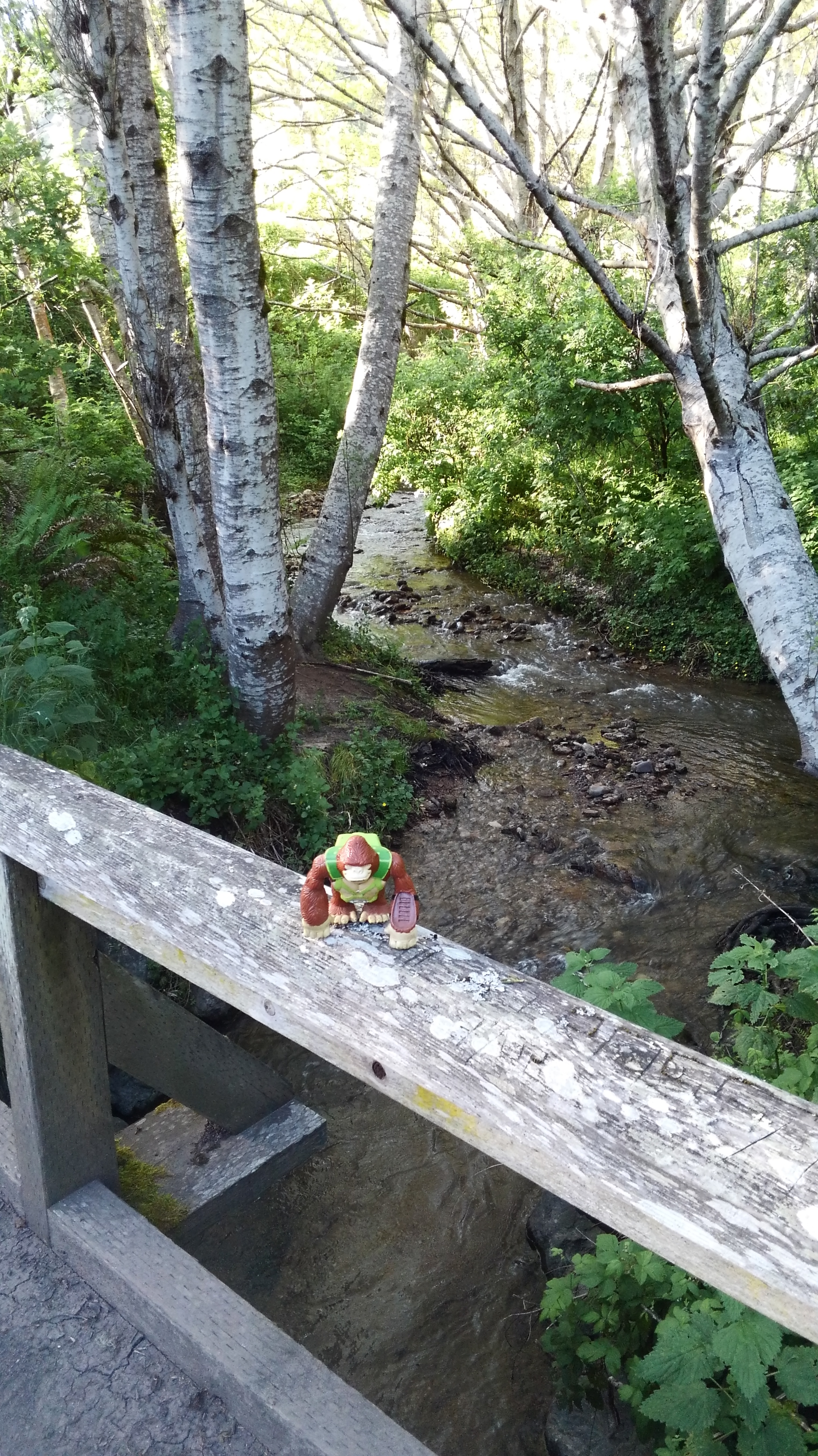
About a mile and a half past where I picked it up from the Meadow trail, Skyline winds down the west side of the ridge towards but not to the Pacific. The trees open up, and you are in for a heavy dose of sea breeze and sunlight. It cuts back inland to cross Coast Creek via a wooden bridge. I snuck off to the side here,and found a place to force my feet into the frigid creek.

KIMG0657.JPG
The bridge across Coast Creek

I wasn’t at blisters yet, but I could feel them coming.

Work boots aren’t hiking boots. Good Advice from Direct Experience.

Happily, I was less than a mile at that point from Glen Camp, though I likely hiked 6.5 miles overall taking the scenic route.


The walk-in campsite has twelve designated sites fanning out from a vault toilet. Each campsite has a table, fire ring and an enclosure to protect your food from ambitious raccoons. There is also, unpublicized, a water spicket available for use. I had to hang my hammock over some pretty steep hillside, but otherwise had no complaints.

KIMG0658.JPG
Glen Campground – site 12.

In April, the overnight low reached the low 40’s, maybe upper 30’s. I had to use all my layers.

In the morning, after a leisurely – for me – breakfast, I conceded to my blisters and took a more direct route to the wide and sunny Bear Valley trail. With the ridge to my west, and Divide Meadow refusing to block any morning sun to my east, and limp-marched back to the visitor center.

KIMG0649

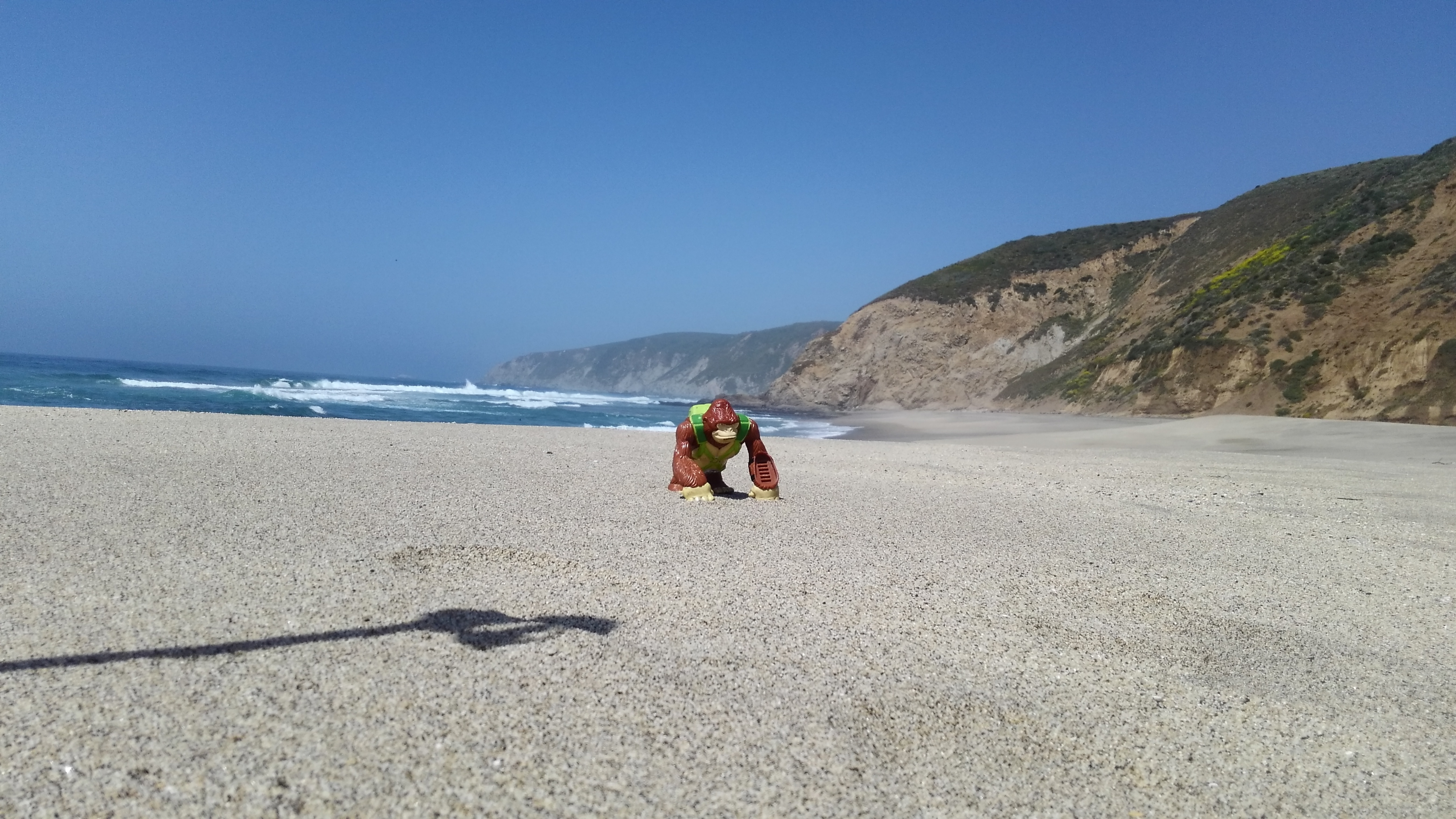
Even at that pace, I had time to drive out to McClure’s Beach towards the north tip of the Peninsula. You reach it via a narrow road winding sharply through prairie covered hills, where you are not likely to get out of 4th gear. The short trail follows a drainage to a wide beach flanked by tide pools. Worth it even with blisters.

KIMG0674.JPG
Bongo at McClure’s Beach

Worth it more: the bar in Olema, the tiny town that guards the entrance to the park, where I had oysters and whiskey for a late-late lunch. Cannot recommend that sort of thing enough.

So, Easy, Scenic and Fun. The hard part is getting there – and totally worth it.

Willow Creek (whatever)

The city of Prescott has three man-made reservoirs in or about city limits, and Willow Creek is the most accessible, and arguably the most scenic. While you can float a non-powered boat on it, and fish and bird-watch, or even peer into the excavated homes of the long-gone natives if you time it right, the attraction – at least for me -is as a hiking destination.

1535579172003

There are three trailheads, and I picked the only one with a parking fee – City-run Willow Lake Park on the north side.

Let’s stop here and clarify: the body of water is called Willow Lake, Willow Creek Lake, Willow Creek Basin or Willow Creek Reservoir depending on what source you look at. It is all the same body of water.

willow_lake_loop_trail_map

The city park is the most developed site, with the boat launch and the well-guarded aboriginal ruins. They were closed when I was there, and thus we skip right past them. The park asks for a $3 fee paid by an honor-system kiosk. Or you could park at the ball-fields of adjacent Heritage Park – as I did, and hoof in for half a mile extra.

The lake, and the 6 mile trail that wanders around its perimeter can be accessed by the Jim McCasland Willow Creek Park, which has a ball-field and a dog park, on the east shore, and some undeveloped gravel parking areas on the south shore. McCasland, for your planning convenience, also has restrooms and water fountains. The south lots have only trash cans.

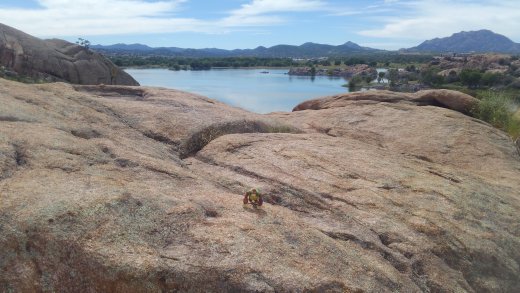
Back on the north shore, the city park is adjacent to a trailer park and a campground, and a number of social trails connect the two. I went clockwise, past all of these and into the portion of the Granite Dells, a large, relatively famous jumble of granite boulders and mounds that line the north and east shores of the lake.

1535579412380

Like all trails through this terrain, the path has a lot of up and down and round and round and is often a scramble over granite marked only by spots of white paint.

In the NE corner, some side trails loop further into the Dells, but I skipped these, to budget time and energy. Originally, I was just going to go to the dam, and then turn back. Past the junction with the loop trails, heading south through the boulders, you can look for the red bridge, though if you take the offshore leg of the loop you could miss it, before you wind down into the valley behind the dam.

I have been through this valley both wet and dry. Dry is far more likely, but trails exist which will get you across when the water is spilling out from the concrete barrier.

On the south wall of this valley are the stairs, rail-road tie stairs, which will march up 200’ in elevation to the last leg of the journey south through the Dells.

Here I reasoned, correctly I still believe, that retracing the just under two-mile journey from the city park to the top of the stairs would consumed as much energy as continuing along the remaining four miles ahead of me, and I decided to press forward around the lake.

Another half mile of big boulders, including a close encounter with the edge of the lake, that required a bit of rock hopping, separated the stairs from more open terrain. You can avoid the edge of the lake via a loop I did not take.

1535579517054

Both will dump you into the shadeless, swamp-grass covered expanse of the south-eat edge of the lake, The map claims this part of the trail could be submerged, but this is rare. When I traveled it, it was a dry dirt track through the tall grass and swarms of insects that live there. This turns west and rises into the hard-pack of the southern shore. Power lines and an intermittent fence-line separate the trail from Willow Road to the south. Past the gravel parking areas, and across a wooden bridge, the trail wanders away from the road, and skirts some low granite formations before turning north along the east shore.


forklift stuntsIt will dip in and around some wooded washes before reaching McCasland Park, where I found the water and restrooms nearly life-saving. Past there the trail wanders through scrub along the shore, passing Embry-Riddle University on the far side of the road, and finally back to the city park sprawling along the north shoreline.

I did the trail in about three hours. The Dells are Hard, the rest of the trail is easy, but the Dells are the worthwhile portion in my opinion. These Dells would be a premier destination for burning off the energy of junior high boys. Even as an adult, this hike remains a good way to kill a few hours if you happen to be in Prescott, in good weather, with time on your hands, and reasonably sturdy shoes.