The Bajada Trail – main

A bajada is the mound of run-off sediment skirting the edge of the mountain. It is not quite Spanish for “Alluvial Fan”, but they are functionally the same thing.

The Bajada Trail winds up and across its namesake across the San Juan Valley in the Phoenix South Mountain preserve. Or, rather, the main western portion des this. The eastern third of the trail is basically a connector trail we have written about elsewhere.

The portion we write about here connects the San Juan Bicycle Center with the San Juan Lookout, running from its junction with the Max Delta Trail (at the lot) to its’ junction with the National Trail on the west end of the park. You then follow the National Trail northwest to the lookout.

This is often done as a loop hike with the Alta Trail. If so, regardless of direction, do Alta is the harder of the two, and I always recommend doing the hard part first. If you do it as a loop, take a lunch.

I did this as a car shuttle. My plan was to park at the bike lot, and then have a friend drive me to the Curtis Saddle Trailhead. However, we lucked into one of those Brigadoon-like morning when the vehicle road to San Juan Lookout was actually open to actual vehicles. So, he dropped me off there instead.

The route is National Trail of Bajada Trail to the bike center – a route that is about 4.3 miles one way. Most people can do it in a couple of hours.

National Trail heading out from the lookout is what you picture single-track trail through the low desert to look like: Packed dirt wide enough for one pedestrian, winding through the cactus. There are not a lot of landmarks. Sure, to the west, AZ 202 crosses in front of the casino, but the trail itself has few features. The junction with the Maw Ha Tuak Perimeter Trail. A stand of teddy-bear cholla. A stand of chain fruit cholla. A stand with both of them together. A geologic marker. You cross three small washes, then a big one, and then East San Juan Road. On the far (south) side of that you come to the junction with the western terminus of the Bajada Trail. 

The National Trail, also called the Maricopa Trail heads off further southwest until it turns east and charges up the main Gila Range to the top ridge. It will continue east across that ridge to the other end of the park.

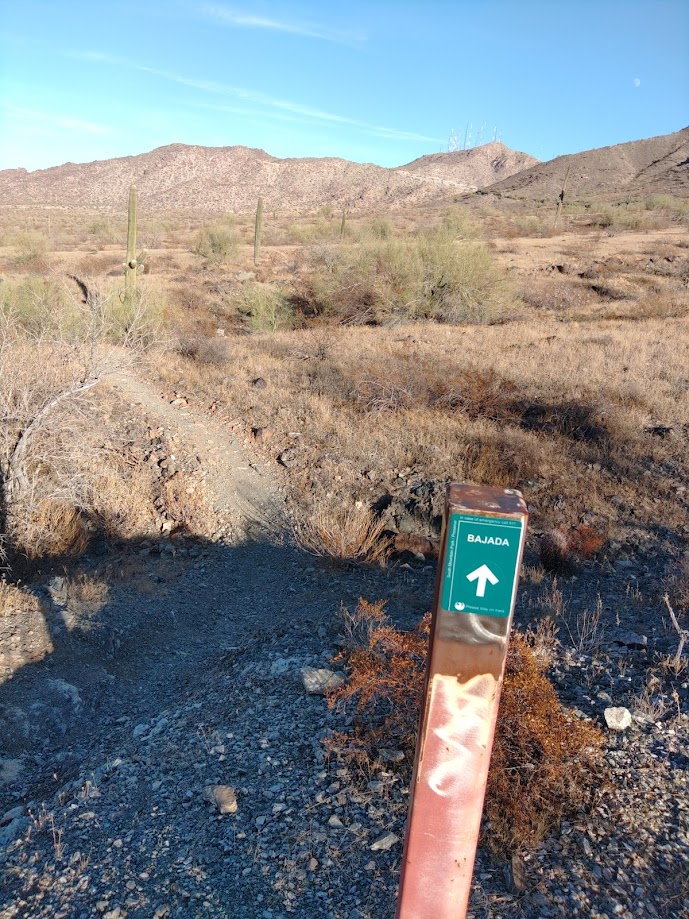
I took the Bajada Trail, of course. It promptly crossed the grey-gravel expanse of the main San Juan wash, and then began a lesser climb up the mountain, turning east kinda-sorta along the top of the bajada.

When the road is closed, and you get some distance from the freeway, this is one of the quietest sections in the park.

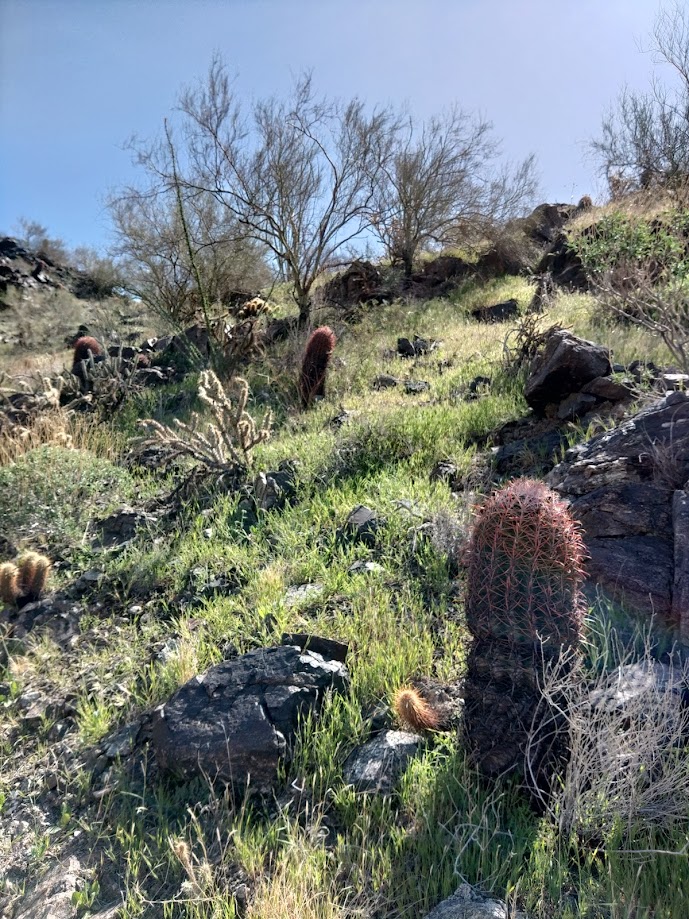
The trail will go up the berm and down the wash and up the berm for most of its remaining length (either direction). It is in excellent shape, a little rocky in places, blue and black basalt with a little gypsum for color, but you can do this in tennis shoes.  The entire length is a shadeless march through stunted palo-verde trees, bone dry creosote and a scattering of cacti.
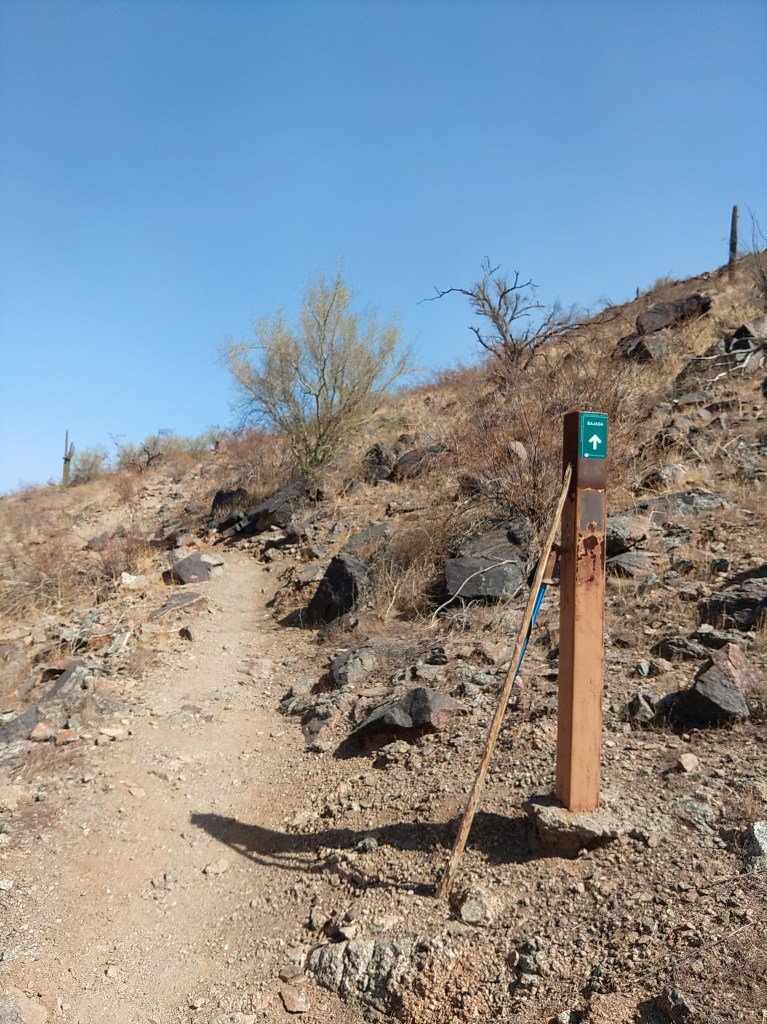
The terrain is not your problem. Like all hikes in this park, or this area, do not attempt this in summer unless you start marching in the predawn gloom. The entire hike I noted two places (both washes) with enough shade that a grown human could sit down within.

Below you (north) East San Juan Road follows the wash through the relatively quiet canyon. Towards the end, after one of the few sustained climbs, the trail with turn north and descend towards the road. Before you get there, as you start to enter the main wash, you will reach the junction with Alta Trail.

You are a half-mile from the trailhead. You can guzzle some water now.

Don’t cross the wash. Stay on Bajada as it turns east again, though and then out of the wash. Then across the desert floor a little farther to pavement.

If you look up the hill during this passage you will see mine trailings, and perhaps some social trails going up towards same. There is at least one open mine shaft still existing on those slopes, but you are on your own with that. When crawling about in mine-shafts, you are betting your life on the engineering acumen and diligence of whatever miner dug this 100+ years ago, and I cannot recommend that.

The bike lot has trashcans, but no other services. The San Juan Lookout has nothing but an old ramada and signage.


The Alta Trail

This is the toughest trail in the Phoenix South Mountain Preserve. It is also one of the more lightly used one, as, aside from the difficulty, none of its access points are from parking lots. Originally built by CCC and convict labor in the 1930’s , it is one of the oldest existing trails in the park. And one of the best – if you’re up for it.

Panoramic shot on the western slopes

You can do it as a loop with the Bajada or even the National trail, and that will take all day. If you do it as a car-shuttle, no one will judge you. Either way, it is worth doing – at least once.

This article is part of an ongoing series about hikes in the South Mountain Preserve.

My son waiting patiently on “Dead Man’s Trail”

We  (my son joined me) parked one car at the Curtis Saddle “Trailhead”. We only call it a trailhead because it is so marked upon a map. At the eastern dead-end of Estrella Drive, just east of 43rd Ave, where it turns to dirt, you can find several places to park along the barbed wire fence lining the south side of the road. There are no services.

The elevation here is about 1140 feet.

A short connector trail (called Dead Man’s trail in some sources)  charges up the rock slopes, bisecting the Ma Ha Tauk Perimeter Trail (aka the East Laveen Trail) before winding south through the actual Curtis Saddle and down to the San Juan Lookout.

San Juan Lookout is one of several parking lots in the park where you are no longer allowed to realistically park. That’s another article. To our purpose it is a trail hub granting access to the National or Maricopa trail, which crosse the entire park east-west, the Bajada Trail which goes across the gentle slopes of the San Juan Valley to the east, and the Alta Trail, which also heads east – but straight up the slopes of the Ma Ha Tauk mountains.

Alta is Spanish for “high”

It has always been my preference to go up the hard way – while your feet are fresh, and then down the easy way, which is why we describe this hike west to east. The western climb has some switch-backs, but it has just as many places where you are going to be obliged to use your hands or maybe your knees to get up the rock-surface portion of the trail.

There is one particularly daunting spot, where a straight climb up scree leads you to a trail marker, taunting you. This is a trap. Look behind you. The trail actually switches sharply back to climb the slope in a more rational manner.

This old trail winds up the oldest of the two ranges that form the park. This range and the western portion of the Gila range (due south) are composed of Precambrian gneiss pushing up granite 1.7 billion years ago. It has been slowly eroding ever since. You’re helping.

Vista from a false summit

There are a couple false summits where you can pant and take pictures but the literal high point is also approximately the half-way point, around 2.5 miles, when you reach the ridge crest and can see both the north and south sides of the range. This is 2400 feet, depending upon which rock you sit on. That’s why you’re tired.

The highest point of the range, at just under 2500′ is called Maricopa peak – on some maps.

From here, the trail winds up and down the high slopes on the north side for a mile or so before cresting again. On the way, you can see the farming village of Laveen and the gated communities that increasing surround it. You can also absolutely win a game of desert cactus bingo along its slopes, passing stately saguaros, whispey ocotillos, stunted palo -verde trees, angry cholla and in the right season delicate wildflowers. If you’re lucky you’ll see some hawks. If you’re less lucky – jet planes.

The last mile and a half winds down the southeast slopes in lunatic switchbacks – a hallmark of CCC trail engineering. Towards the bottom, you might find where the original course was abandoned for a straighter line along the wash.

You will cross that wash, and the trail flattens as it approaches the San Juan Bicycle Center, where you can find the Bajada Trail and the Max Delta. The San Juan Bicycle Center is another not-really-open parking lot that we made fun  of  described in the Max Delta trail description. It has trashcans and places to sit, but no other services. There are other normally open parking lots just down the road.

We reached the Bicycle Center from Curtis Saddle in just over 4 hours – but I hike slow and take  notes and pictures. My son could have easily shaved an hour off of that were he not waiting on me.

The Bajada Trail

This is the east section (about a third) of the trail, from its junction with the Los Lomitas Trail to the San Juan Bicycle Center and Sometime Parking Lot. Except I actually hiked it and describe it in the opposite direction.

This is part of my South Mountain Infrastructure Loop.

The San Juan bike lot marks about a third of this trail’s overall length. For the rest of this trail and its’ journey west see the main trail description.

Bajada Trail main

The Max Delta Trail  T’s with the Bajada trail near the San Juan Bike Center. To the right, Bajada proceeds roughly southwest to the Alta trailhead deeper in the park. To the left, the section I wanted went roughly northeast, toward my car.

Most of this portion of the trail follows the mountainside just below Dobbins Lookout Road, so this is not a wilderness experience at all. But oh my – lookit the city out there to the north. The trail picks it way across the slope for about three-quarters of a mile before turning north and downwards. Soon, it will merge with the Ranger Trail. By this point, has widened into a service road.

The building you are heading for is the Valley of the Sun Quarter Midget Association Race Track where they race small vehicles for reasons.

Immediately to the west of that facility, Bajada will end at a four-way junction. The Ranger Trail continues straight/down/south towards the Five tables trailhead. The Derby Loop continues left/west until its junction with the middle portion of the Max Delta Trail.

Los Lomitas Trail goes to the right/east towards the Big Parking Lot. That is the way if you are following the Infrastructure Loop.

Otherwise, you are just at the end of this trail.

Max Delta Trail

Max Delta is an entry level trail through the entrance of the preserve. It is named after the mine shaft that lies buried and officially off limits towards its southern terminus. That is another article. This is just about the trail.

This trail is part of the Infrastructure Vista Loop Hike.

From the trailhead at the entrance (across from Scorpion Gulch) the flat, wide trail winds west then south, narrowing as it climbs up the ridgeline it will follow for half its’ distance.  Your first landmark is a monument and plaque commemorating the city elders who re-designated the park into a Phoenix South Mountain Preserve.

If you’re new here, Phoenix was founded by developers who eventually become old and rich philanthropic preservationists determined to protect the precious desert from the new wave of developers. Somewhere in the 1970’s, 1973 – by the plaque, the old developers city elders started designating the “park” as a “preserve”.

Litigation followed. But here it is, still more -or-less preserved.

Heading south, the trail intersects with the interpretive trail behind the old visitor’s center. This is one of the last of the original CCC buildings that still sees actual use.  Looking out, you can easily see the new visitor center in the distance, and the work compound just across the street. The old administration building still has restrooms and water available to the public. The small ranger office and gift shop it once house have moved elsewhere.

The gunfire you hear from the far side of the ridge is not random. There is a gun range on the other side, both the private Phoenix Rod and Gun Club and the Phoenix Police training range.  These have been here since 1948, when these slopes were still a “park”. They expanded somewhat contentiously in the 1990s, closing the trailhead on the terminus of 7th Ave at Olney.

They are not supposed to shoot hikers, even accidentally, even hikers off the trail, but the party investigating will be the one most likely to have shot you, so stay on this side of the ridge.

Climbing down from the ridge you cross low hills with patches of barrel cacti, then saguaro then teddy-bear cholla. The trail goes down into a wash and Y’s on the far side. Max Delta proceeds south, to your right. To the left, the trail crossing the road is the Derby Trail aka Los Lomitas. You can take that turn and shave a good 40% off the loop hike. But for now, we follow the Max Delta.

The dirt turns grey as the trail crosses the arroyo, finally a bit away from the road.  You will cross another road, along with numerous washes, but it gives brief illusions of crossing open desert. Look for mine pits along the way.

The gates were closed at the San Juan Bike Hub, as this was not the first weekend of the month. It’s not closed to people, but certainly closed to vehicles. Even on the special weekend, it just affords closer parking to those who want to hike or bike down San Juan Road – which is another article.  There are some amphitheater seats which were not shaded in the afternoon by the large metal canopy, a trash receptacle, and a good number of empty parking spaces for both bikes and cars. I was the only person there when I arrived, and took a break there, surrounded by this rust-colored monument to municipal expenditure.

Then I proceeded east down the Bajada Trail to continue on with the loop.

The South Mountain Infrastructure Vista Loop

This is a half-day hike within the Phoenix South Mountain Preserve. This is a sub-hub for that overall hub page.

This half-day hike combines three established trails and a bit of mild bushwhacking  to make a circuit of the south-central portion of the park, where most of the development is located. As described, the circuit takes the Max Delta Trail south and west to its junction with the Bajada Trail. Taking the Bajada east we turn north to it terminus with the Ranger Trail, then shortly its junction with the  Los Lomitas Trail. We take the Los Lomitas east and then north again, where it merges with Box Canyon Trail, to dump into the parking lot, completing the circui

I parked in the expansive Environmental Center/Ranger Station /Event parking lot and then bushwhacked roughly north, across the big wash to Scorpion Gulch, then across the street to the Max Delta trailhead proper.  It is not hard. Many have done this before you, but it is not an official route.

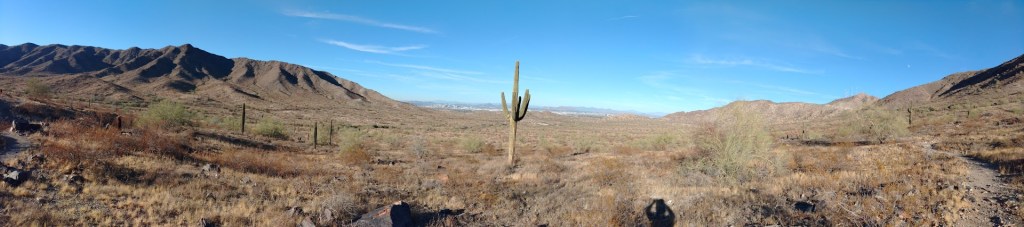
Panoramic view from the Bajada Trail

All three of these hikes are moderate and easy to access. Moderate means you can do these in tennis shoes, but not sandals. They are not, as the name suggests, quality wilderness experiences. It is more of a walking tour of the municipal portion of the park.  You can take non-hiker-hikers on it, and see some desert, and never be more than an hour from rescue and two hours from some sort of toilet.

Max Delta across 2.2 miles, will take you along the entrance road, past the old park HQ, then south across a short stretch of open desert to the San Juan Bike Center.

Bajada Trail, at least this mile of it, heads east, following the mountainside below Telegraph Pass Road before turning south to connect with the Ranger trail, and then the junction with Los Lomitas.

Las Lomitas, over the roughly 2.5 miles, winds through the various ramada compounds before merging with Box Canyon trail and dumping out alongside the accessible trail to the parking lot.

That’s just under six miles total. I did it in four hours hike time, while taking notes and pictures.

Hike date: 23 November 2023