The Bajada Trail – main

A bajada is the mound of run-off sediment skirting the edge of the mountain. It is not quite Spanish for “Alluvial Fan”, but they are functionally the same thing.

The Bajada Trail winds up and across its namesake across the San Juan Valley in the Phoenix South Mountain preserve. Or, rather, the main western portion des this. The eastern third of the trail is basically a connector trail we have written about elsewhere.

The portion we write about here connects the San Juan Bicycle Center with the San Juan Lookout, running from its junction with the Max Delta Trail (at the lot) to its’ junction with the National Trail on the west end of the park. You then follow the National Trail northwest to the lookout.

This is often done as a loop hike with the Alta Trail. If so, regardless of direction, do Alta is the harder of the two, and I always recommend doing the hard part first. If you do it as a loop, take a lunch.

I did this as a car shuttle. My plan was to park at the bike lot, and then have a friend drive me to the Curtis Saddle Trailhead. However, we lucked into one of those Brigadoon-like morning when the vehicle road to San Juan Lookout was actually open to actual vehicles. So, he dropped me off there instead.

The route is National Trail of Bajada Trail to the bike center – a route that is about 4.3 miles one way. Most people can do it in a couple of hours.

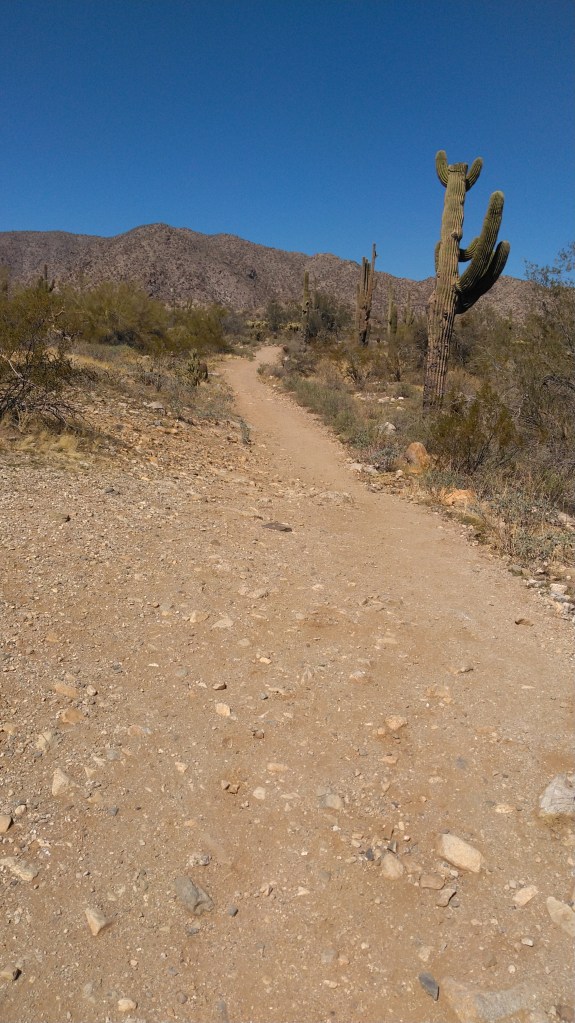
National Trail heading out from the lookout is what you picture single-track trail through the low desert to look like: Packed dirt wide enough for one pedestrian, winding through the cactus. There are not a lot of landmarks. Sure, to the west, AZ 202 crosses in front of the casino, but the trail itself has few features. The junction with the Maw Ha Tuak Perimeter Trail. A stand of teddy-bear cholla. A stand of chain fruit cholla. A stand with both of them together. A geologic marker. You cross three small washes, then a big one, and then East San Juan Road. On the far (south) side of that you come to the junction with the western terminus of the Bajada Trail. 

The National Trail, also called the Maricopa Trail heads off further southwest until it turns east and charges up the main Gila Range to the top ridge. It will continue east across that ridge to the other end of the park.

I took the Bajada Trail, of course. It promptly crossed the grey-gravel expanse of the main San Juan wash, and then began a lesser climb up the mountain, turning east kinda-sorta along the top of the bajada.

When the road is closed, and you get some distance from the freeway, this is one of the quietest sections in the park.

The trail will go up the berm and down the wash and up the berm for most of its remaining length (either direction). It is in excellent shape, a little rocky in places, blue and black basalt with a little gypsum for color, but you can do this in tennis shoes.  The entire length is a shadeless march through stunted palo-verde trees, bone dry creosote and a scattering of cacti.
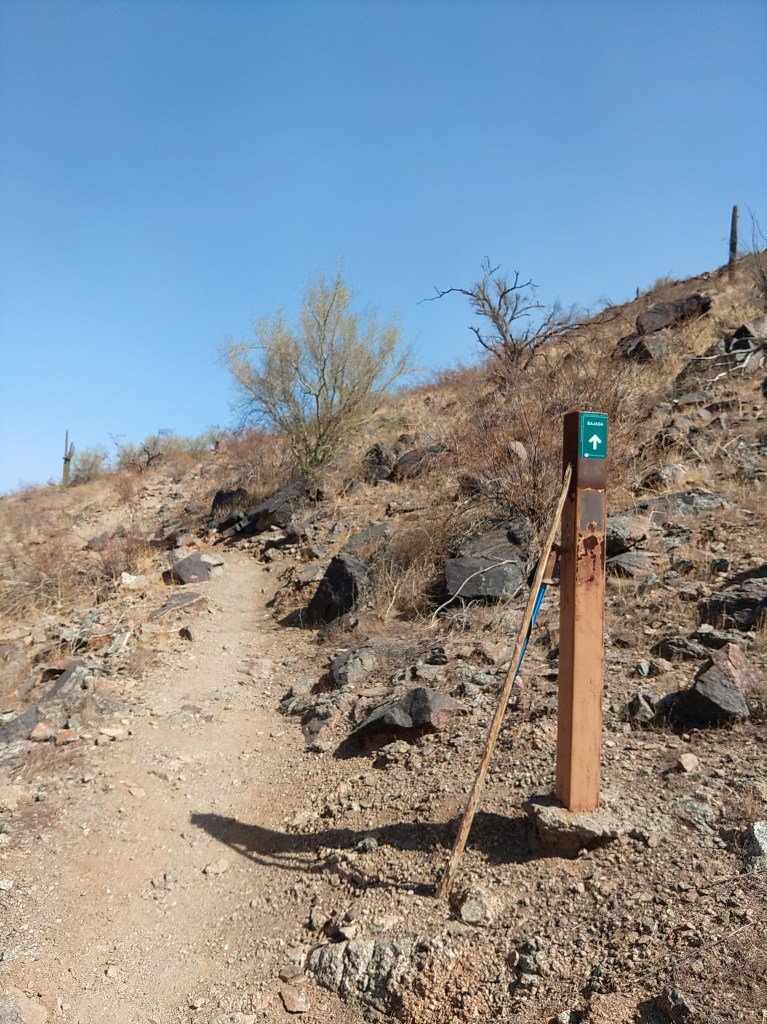
The terrain is not your problem. Like all hikes in this park, or this area, do not attempt this in summer unless you start marching in the predawn gloom. The entire hike I noted two places (both washes) with enough shade that a grown human could sit down within.

Below you (north) East San Juan Road follows the wash through the relatively quiet canyon. Towards the end, after one of the few sustained climbs, the trail with turn north and descend towards the road. Before you get there, as you start to enter the main wash, you will reach the junction with Alta Trail.

You are a half-mile from the trailhead. You can guzzle some water now.

Don’t cross the wash. Stay on Bajada as it turns east again, though and then out of the wash. Then across the desert floor a little farther to pavement.

If you look up the hill during this passage you will see mine trailings, and perhaps some social trails going up towards same. There is at least one open mine shaft still existing on those slopes, but you are on your own with that. When crawling about in mine-shafts, you are betting your life on the engineering acumen and diligence of whatever miner dug this 100+ years ago, and I cannot recommend that.

The bike lot has trashcans, but no other services. The San Juan Lookout has nothing but an old ramada and signage.


The Alta Trail

This is the toughest trail in the Phoenix South Mountain Preserve. It is also one of the more lightly used one, as, aside from the difficulty, none of its access points are from parking lots. Originally built by CCC and convict labor in the 1930’s , it is one of the oldest existing trails in the park. And one of the best – if you’re up for it.

Panoramic shot on the western slopes

You can do it as a loop with the Bajada or even the National trail, and that will take all day. If you do it as a car-shuttle, no one will judge you. Either way, it is worth doing – at least once.

This article is part of an ongoing series about hikes in the South Mountain Preserve.

My son waiting patiently on “Dead Man’s Trail”

We  (my son joined me) parked one car at the Curtis Saddle “Trailhead”. We only call it a trailhead because it is so marked upon a map. At the eastern dead-end of Estrella Drive, just east of 43rd Ave, where it turns to dirt, you can find several places to park along the barbed wire fence lining the south side of the road. There are no services.

The elevation here is about 1140 feet.

A short connector trail (called Dead Man’s trail in some sources)  charges up the rock slopes, bisecting the Ma Ha Tauk Perimeter Trail (aka the East Laveen Trail) before winding south through the actual Curtis Saddle and down to the San Juan Lookout.

San Juan Lookout is one of several parking lots in the park where you are no longer allowed to realistically park. That’s another article. To our purpose it is a trail hub granting access to the National or Maricopa trail, which crosse the entire park east-west, the Bajada Trail which goes across the gentle slopes of the San Juan Valley to the east, and the Alta Trail, which also heads east – but straight up the slopes of the Ma Ha Tauk mountains.

Alta is Spanish for “high”

It has always been my preference to go up the hard way – while your feet are fresh, and then down the easy way, which is why we describe this hike west to east. The western climb has some switch-backs, but it has just as many places where you are going to be obliged to use your hands or maybe your knees to get up the rock-surface portion of the trail.

There is one particularly daunting spot, where a straight climb up scree leads you to a trail marker, taunting you. This is a trap. Look behind you. The trail actually switches sharply back to climb the slope in a more rational manner.

This old trail winds up the oldest of the two ranges that form the park. This range and the western portion of the Gila range (due south) are composed of Precambrian gneiss pushing up granite 1.7 billion years ago. It has been slowly eroding ever since. You’re helping.

Vista from a false summit

There are a couple false summits where you can pant and take pictures but the literal high point is also approximately the half-way point, around 2.5 miles, when you reach the ridge crest and can see both the north and south sides of the range. This is 2400 feet, depending upon which rock you sit on. That’s why you’re tired.

The highest point of the range, at just under 2500′ is called Maricopa peak – on some maps.

From here, the trail winds up and down the high slopes on the north side for a mile or so before cresting again. On the way, you can see the farming village of Laveen and the gated communities that increasing surround it. You can also absolutely win a game of desert cactus bingo along its slopes, passing stately saguaros, whispey ocotillos, stunted palo -verde trees, angry cholla and in the right season delicate wildflowers. If you’re lucky you’ll see some hawks. If you’re less lucky – jet planes.

The last mile and a half winds down the southeast slopes in lunatic switchbacks – a hallmark of CCC trail engineering. Towards the bottom, you might find where the original course was abandoned for a straighter line along the wash.

You will cross that wash, and the trail flattens as it approaches the San Juan Bicycle Center, where you can find the Bajada Trail and the Max Delta. The San Juan Bicycle Center is another not-really-open parking lot that we made fun  of  described in the Max Delta trail description. It has trashcans and places to sit, but no other services. There are other normally open parking lots just down the road.

We reached the Bicycle Center from Curtis Saddle in just over 4 hours – but I hike slow and take  notes and pictures. My son could have easily shaved an hour off of that were he not waiting on me.

The South Mountain Infrastructure Vista Loop

This is a half-day hike within the Phoenix South Mountain Preserve. This is a sub-hub for that overall hub page.
This half-day hike combines three established trails and a bit of mild bushwhacking  to make a circuit of the south-central portion of the park, where most of the development is located. As described, the circuit takes the Max Delta Trail south and west to its junction with the Bajada Trail. Taking the Bajada east we turn north to it terminus with the Ranger Trail, then shortly its junction with the  Los Lomitas Trail. We take the Los Lomitas east and then north again, where it merges with Box Canyon Trail, to dump into the parking lot, completing the circui

I parked in the expansive Environmental Center/Ranger Station /Event parking lot and then bushwhacked roughly north, across the big wash to Scorpion Gulch, then across the street to the Max Delta trailhead proper.  It is not hard. Many have done this before you, but it is not an official route.
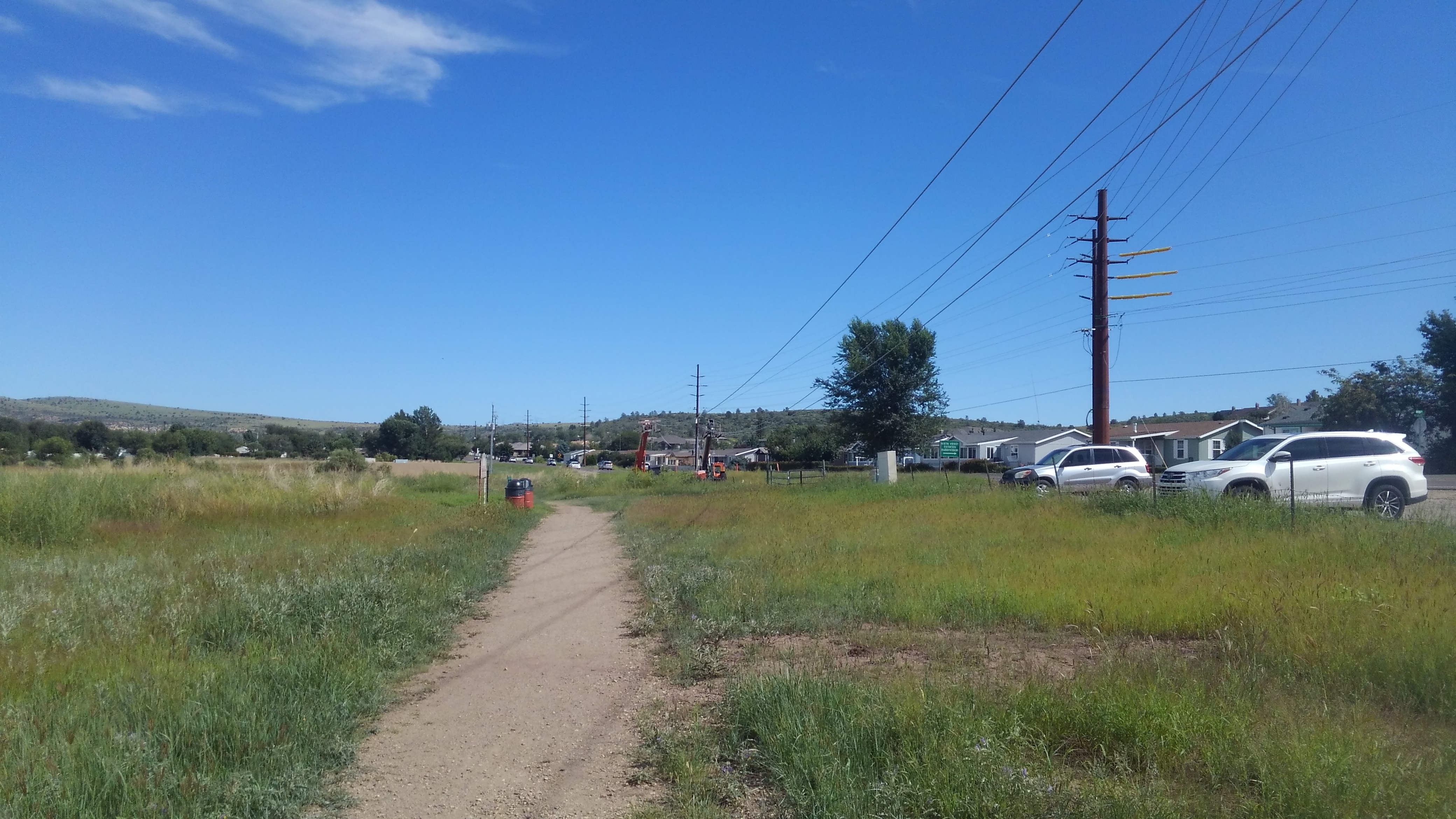
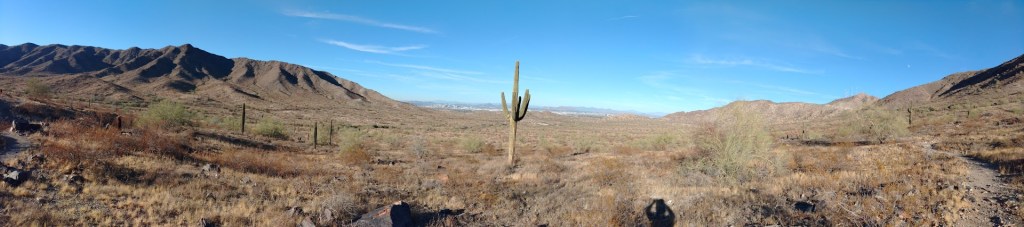
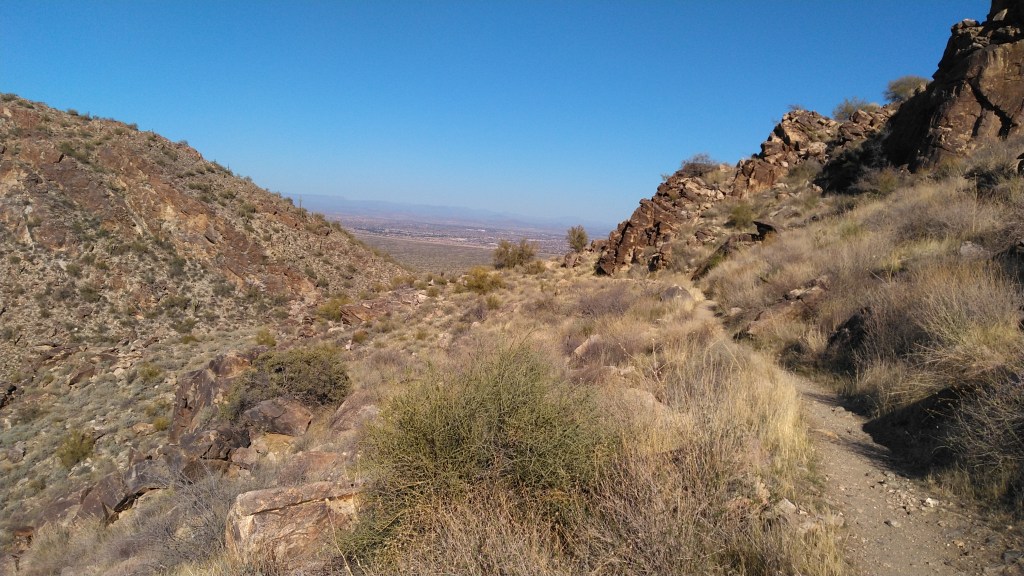
Panoramic view from the Bajada Trail

All three of these hikes are moderate and easy to access. Moderate means you can do these in tennis shoes, but not sandals. They are not, as the name suggests, quality wilderness experiences. It is more of a walking tour of the municipal portion of the park.  You can take non-hiker-hikers on it, and see some desert, and never be more than an hour from rescue and two hours from some sort of toilet.

Max Delta across 2.2 miles, will take you along the entrance road, past the old park HQ, then south across a short stretch of open desert to the San Juan Bike Center.

Bajada Trail, at least this mile of it, heads east, following the mountainside below Telegraph Pass Road before turning south to connect with the Ranger trail, and then the junction with Los Lomitas.

Las Lomitas, over the roughly 2.5 miles, winds through the various ramada compounds before merging with Box Canyon trail and dumping out alongside the accessible trail to the parking lot.

That’s just under six miles total. I did it in four hours hike time, while taking notes and pictures.

Hike date: 23 November 2023

Ford Canyon is a good test without becoming a major expedition.

Climbing into Ford Canyon

If you wonder where you are in hike conditioning, the Ford Canyon loop we are about to describe will answer that question. Also, it will take you away from the city without forcing you to take an actual road trip.

I learned that I have, comfortably, an eight mile hiking range through mountainous terrain. The route I took covered ten miles. So, even though I limped to the car, I have no regrets.

To reach White Tank Mountain Regional Park, take Olive Road (Dunlap in Phoenix) west until it basically dead-ends at the park’s guard shack.  How you get to Olive Road is on you. One note: you would think that there would be an exit for Olive on Loop 303, but there is not.

Most of my information on this trail loop comes from my hike on 5 March 2021

White Tank Mountain Regional park is a Maricopa County park covering nearly 30,000 acres centered on the northern portion of the White Tank Mountains. This range rises from the 1100’ valley floor to 4000 foot peaks and separates the Salt River basin where Phoenix is centered from the Hassayampa plain to the north and west.

The park is open from 6am to 8pm, and entry at the gate is $7 per car.

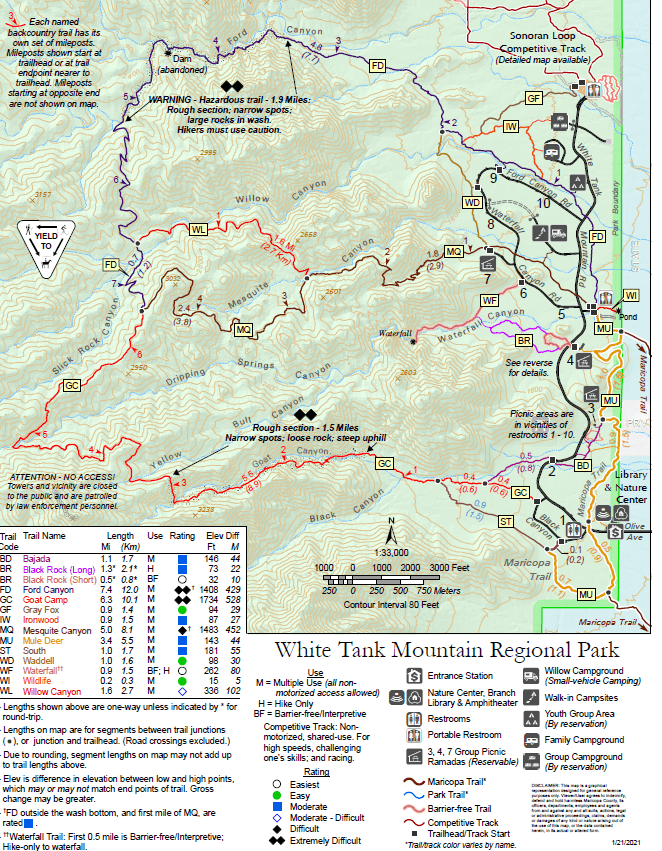
Ford Canyon trail start to finish is 7.4 miles one way, but I skipped the first mile from the terminus (which is a dirt sidewalk through low desert scrub) to jump on at the sub-trailhead at Spot #9 on Ford Canyon Road. I then left the trail at its junction with Willow Canyon to head back down. That route, along with the lower portions of Mesquite Canyon Trail and towards the end Waddell Trail form the loop that led me back to my car.

I parked my car at spot #9. Like nost of the numbered spots in the park, this features a restroom and a scattering of concrete picnic tables. From the signed trailhead, the wide, packed-dirt trail quickly goes in and out of deep wash.

The lower portion of Ford Canyon Trail is a sidewalk of packed dirt across the arroyo. Besides the dirt track, signage looms plentiful and obvious. If you get lost through here, you should reconsider your form of recreation.

The desert welcomes you

Ford canyon early.

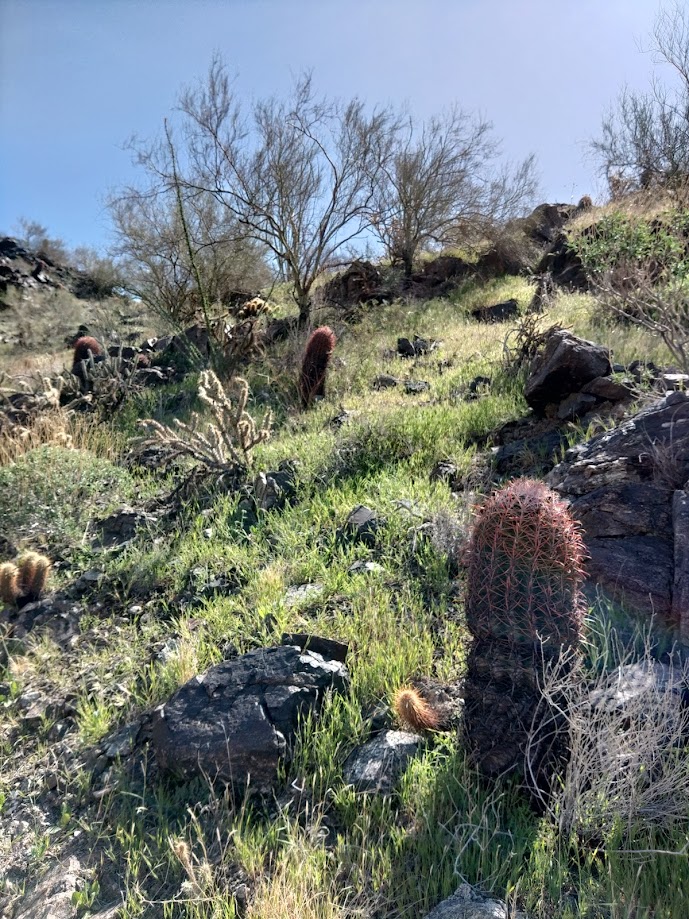
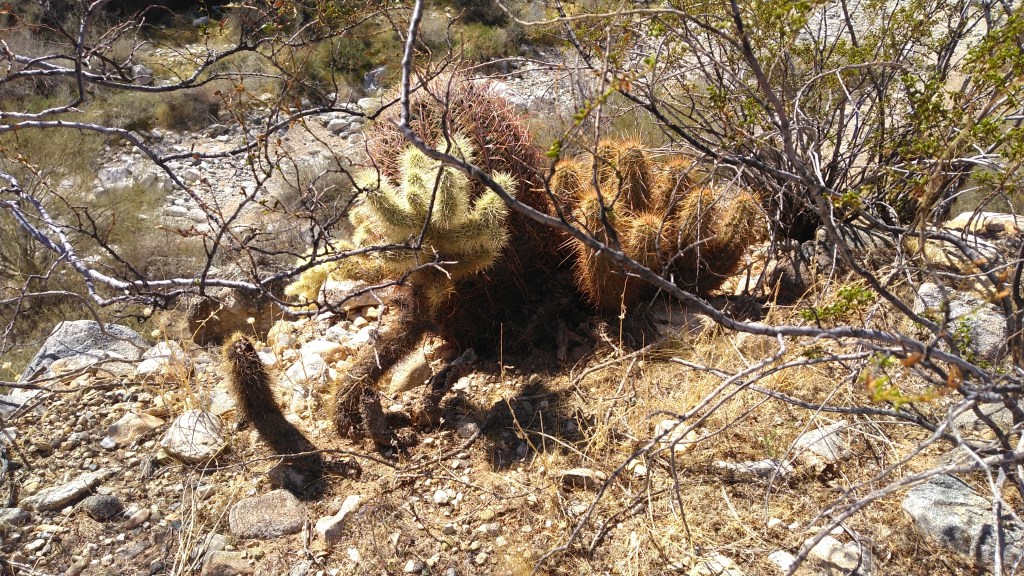
Memorial benches adorn every trail intersection. On my hike day, a proliferation of signage for some trail running event to be held the next day decorated the sides of the path. Teddy-bear cholla stands out as one of many spiny assailants awaiting anyone who would stray off the path as it winds over a low saddle and northwest towards Ford Canyon proper.

Just shy of 2 miles in (all distances are mine – from Spot 9) the warning sign announces that the trail from here – which narrows to a footpath immediately beyond the sign –  becomes hazardous.  

The sign does not lie. This section is on of the hardest trails in the metro area. Only Camelback Mountain and Goat Camp trail (in this very park)  rival it – at least for these next three miles. You will end up using your hands more than once.

The sign

The White Tanks are known habitats for javelina and deer as well as the usual low-desert critters, but the largest vertebrate I encountered on the hike were fat and brazen squirrels.

Much of the exposed granite through here has been whitewashed by the occasional tumult of rain run-off. In early March, some pools of standing water remained. These are, in fact, some of the white tanks that give the region its name.

Towards the top, even the goat trail disappears, and you will end up hunting ribbons along the wash. The route does indeed generally follow the wash. You are a ways from any path across the shoulders.

This is the way. Really.

Lower, you might have seen signs explaining how leaving the trail will increase the erosion. It is true that much of the Sonoran Desert is held together by a layer of microbes imbedded in the soil, and our boot-stomps harm it. Do not worry about that here. This is a wash. There is nothing but granite and sand. Whatever trail ran through here before was washed away by the last rain. Whatever path your footsteps help create will be washed away by the next rain. Choose your steps according to safe, forward progress, and finding the next ribbon. Worry about nothing else.

Somewhere in here, I got my foot stuck in crevace between rocks. I got it out, but not with much grace. It buggered my boots a bit, but I thought little else of it at the time.

That left boot sock had absorbed a good bit of blood by the time I got back to the car.

The old dam is about midway through the wash passage at 3.3 miles and an elevation of 2250’.

Bongo at the abandoned Ford Canyon dam.

At my 4.15 mile mark, a foot path finally appeared, climbing out of the wash. You are through the worst of it, but not yet halfway. The single-track continues through the shadeless slopes as wide switchbacks up the canyon wall, across a saddle and into the next canyon.

You cannot hear the city this far up in the White Tanks. You can, if you are still for a moment, hear the buzzing of insects, the scurry of lizards and the chirping of birds.

You can also hear on occasion the roar of F-18’s flying in and out of their nest at Luke AFB.

Bongo at MM6

The saddle with the 6 mile trail sign marked about 5 miles into my hike, and the half-way point of the route. This saddle stands at 2813’ and was the highest point I recorded on the route. A half mile beyond, the Ford Trail meets the Willow Canyon trail.

Ford Canyon trail goes on another three-quarters of a mile until it Y’s out into the Goat Camp or Mesquite Canyon Trails. I took Willow Canyon instead for it was shorter, easier and more scenic.

A quarter mile past the intersection, Willow Canyon crosses the wash near an old cattle-tank sight. Past this it climbs slightly but steadily even as the canyon floor sinks steadily below you. The footpath winds across the steep slope, revealing intermittent vistas of the west valley.

Willow Canyon Trail

At 7.2 miles, Willow Canyon T’s into Mesquite Canyon, near the bottom of Mesquite Canyon.

Here the path widens a bit as it switches back down the canyon. Go left (east) to climb out of this canyon, across a ridge, to switch back down a different, unnamed canyon to the south. As you approach the bottom of the switch-backs benches appear – signaling your approach to relative civilization.

Here is also where my feet, particularly my left foot transitioned from fatigue to pain. Constant downhill always brings out the worst in foot problems. So forgive my dearth of superlative language through here. I was just trying to keep going.

By the intersection with the Waddell train, the path has become a packed-dirt sidewalk once more. Take the left (north) up the Waddell Trail.

Waddell Trail which will eventually merge back with Ford Canyon. However, a mile before you get to that point, a short spur will take you to pavement a few hundred yards from Spot #9.

Full Hike = 9.88 miles. It took me 5.5 hours, but I took notes and photos, and covered the last two miles at a -er- measured pace.

I’d still do it again.   

Hualapai Mountain Trail System

Hulapai trails 19

Hualapai Mountain towers over Kingman and surrounding parts,; an island of pine forest in a high desert sea.  High on the slopes, at about 6000 feet, sits Hualapai Mountain regional (county) Park, featuring campgrounds and a trail system wandering around the peaks.

There are several access points, one being right in the campground, but I started from the actual trailhead – and had the place to myself.

From the trailhead (with vault toilets tables and trash-cans) the approach trail follows the wash, past the buried remains of the Silver Bell Mine and finally across a cute little wooden bridge, and up the mountainside.

Hulapai trails 2
The only reason to take the trailhead spur

That leg took me to the campground trailhead, and honestly, unless you are hankering to see a mostly buried silver mine, you can start here and miss nothing. The meat of the hike is the Potato Patch Loop which starts in earnest a hundred feet up the dirt road from the secondary trailhead.

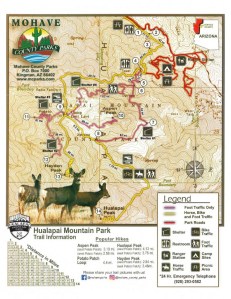
Now, let’s pause a moment and consider that all I had was the free trail guide they gave me at the campsite HQ. Which, so you are warned, is next to worthless. Oh, sure, it has colors and illustrations and explanatory text about the various ecosystem stratas and how regions got their name. But the scale is so small, it is useless as a means to track where you are hiking.

170525-hmp-trail-map-web-789x1024
Don’t hate me because I’m pretty. Hate me because I’m useless.

A common topic of conversation with my fellow hikers – many of whom seemed more experienced than I – was “where do you think we are?”

I went clockwise around that loop. My first stop was Staircase Lookout, named for the CCC built stone stairs that lead up to that lookout point. That would be the last landmark I could properly identify until I hit Camp Levi, which we will get to.


Hulapai trails 24


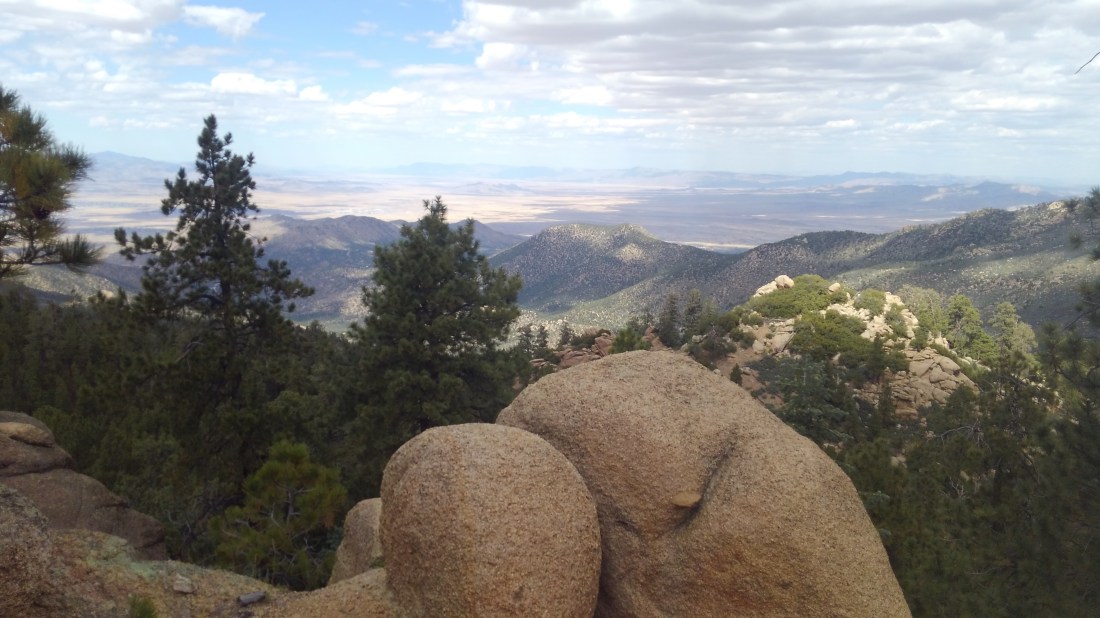
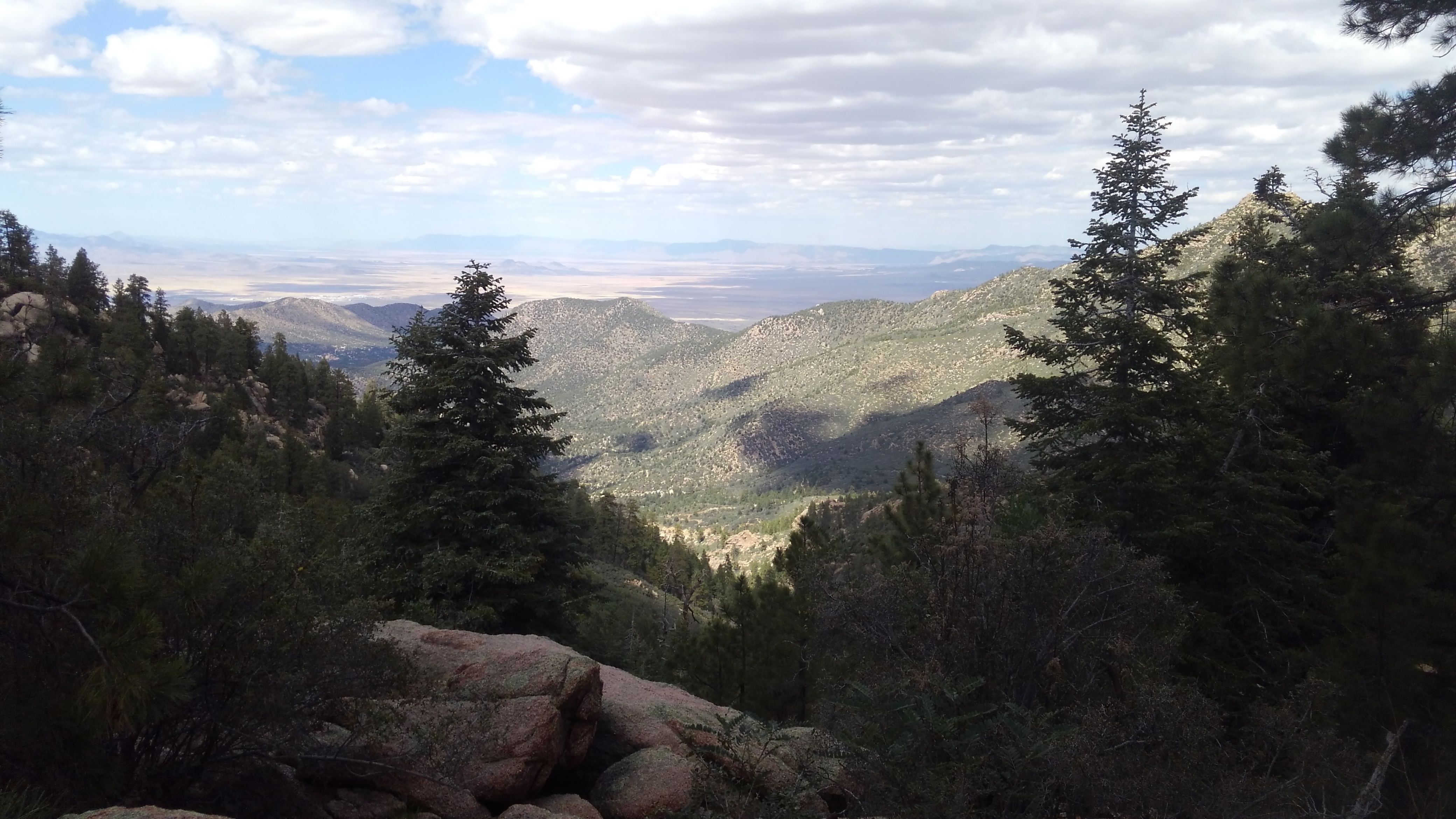
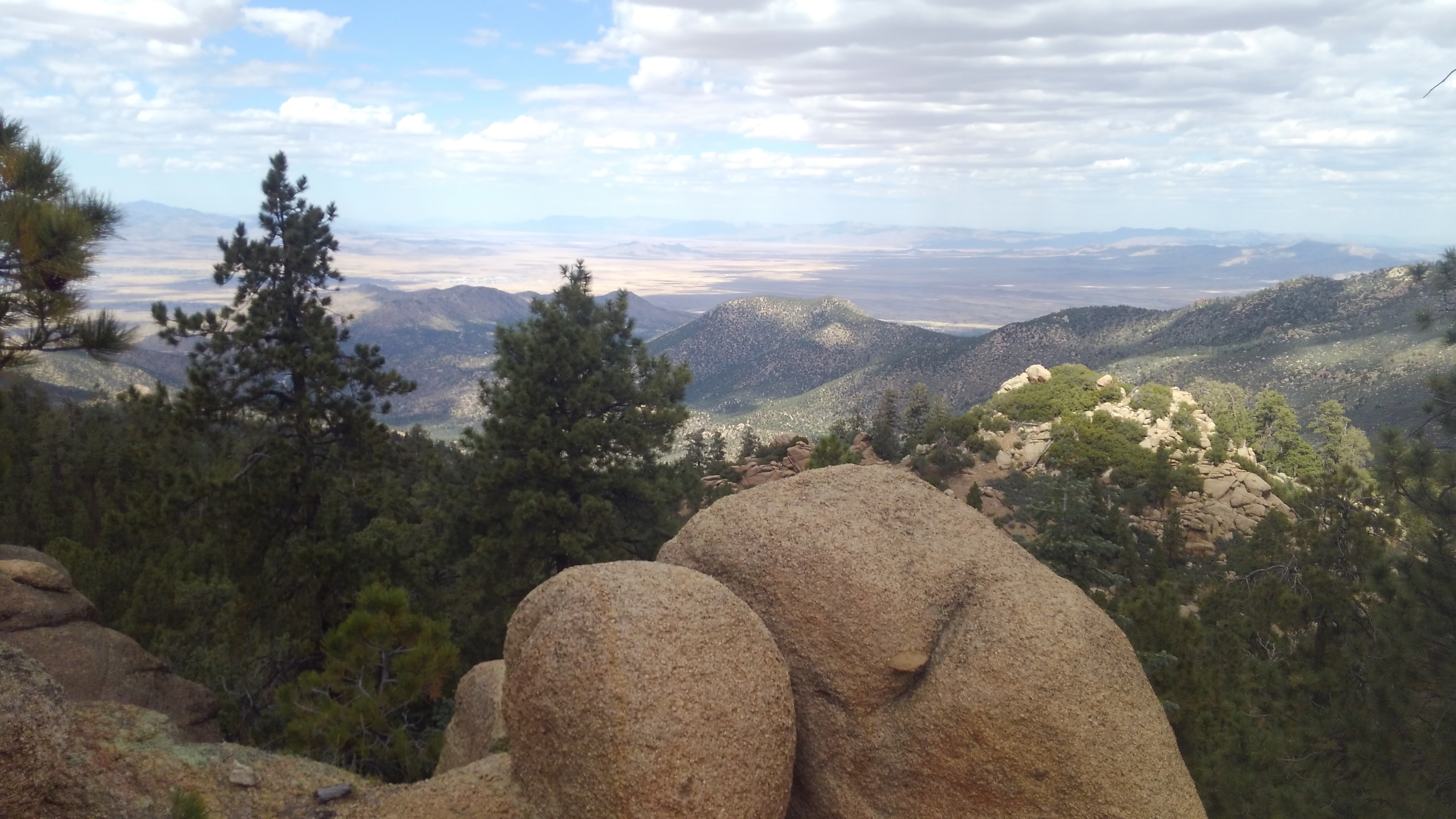
Between those two points, the trail winds around the slopes as a mostly obvious single-track affording views of the high desert vistas (mostly to my left) and cool forests and giant boulders of the mountainside (mostly to my right). The whole loop is around 10 miles, not counting spurs to summit trails. Hualapai has four summit trails, and you would be on your own with any of them.

Everyone gets lost at Camp Levi. This is a Boy Scout camp, and therefore riddled with trails that look official and well made, but really just loop back to camp for whatever reason. I would love to give you solid guidance on how I found my way out of that maze, but really I just kept trying trails in and out of the Valley of the Porta-potties there (there are like twenty spread about) until one of those trails just kept going.


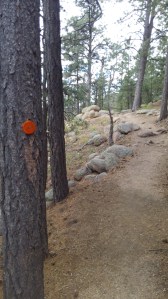
The actual trail will have orange reflectors nailed to trees – though not through Camp Levi – but that’s the true sign you must seek.Then it was more wandering through shady forest around staggering boulders separated by high desert vistas.

Hulapai trails 37
The true sign of the actual trail

The hike is at serious altitude – meaning it will be blessedly a good ten degrees colder than nearby Kingman, but will also work your lungs harder. So while the trail is Medium with pockets of Hard, it will feel like a lot more Hard than it is unless you are accustomed to the lower oxygen ratios.


You can do this hike in tennis shoes. There were some families with kids chased horned toads. I hit some clots of people on a warm Sunday afternoon, but few do the whole circuit. I had the more distant slopes largely to myself.


I clocked a good thousand feet of overall elevation change across the 6 or so miles of actual hike. Most of this was accomplished via switchback.

Hulapai trails 25

Hulapai trails 36

Eventually, I came back to where I started, and followed the spur back to my car.


My tent site cost $17 a night, but a day pass to the park costs $7 per vehicle. Yes – they will check.

Hulapai trails 34

Willow Creek (whatever)

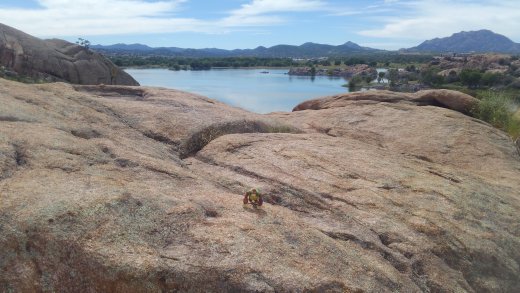
The city of Prescott has three man-made reservoirs in or about city limits, and Willow Creek is the most accessible, and arguably the most scenic. While you can float a non-powered boat on it, and fish and bird-watch, or even peer into the excavated homes of the long-gone natives if you time it right, the attraction – at least for me -is as a hiking destination.

1535579172003

There are three trailheads, and I picked the only one with a parking fee – City-run Willow Lake Park on the north side.

Let’s stop here and clarify: the body of water is called Willow Lake, Willow Creek Lake, Willow Creek Basin or Willow Creek Reservoir depending on what source you look at. It is all the same body of water.

willow_lake_loop_trail_map

The city park is the most developed site, with the boat launch and the well-guarded aboriginal ruins. They were closed when I was there, and thus we skip right past them. The park asks for a $3 fee paid by an honor-system kiosk. Or you could park at the ball-fields of adjacent Heritage Park – as I did, and hoof in for half a mile extra.

The lake, and the 6 mile trail that wanders around its perimeter can be accessed by the Jim McCasland Willow Creek Park, which has a ball-field and a dog park, on the east shore, and some undeveloped gravel parking areas on the south shore. McCasland, for your planning convenience, also has restrooms and water fountains. The south lots have only trash cans.

Back on the north shore, the city park is adjacent to a trailer park and a campground, and a number of social trails connect the two. I went clockwise, past all of these and into the portion of the Granite Dells, a large, relatively famous jumble of granite boulders and mounds that line the north and east shores of the lake.

1535579412380

Like all trails through this terrain, the path has a lot of up and down and round and round and is often a scramble over granite marked only by spots of white paint.

In the NE corner, some side trails loop further into the Dells, but I skipped these, to budget time and energy. Originally, I was just going to go to the dam, and then turn back. Past the junction with the loop trails, heading south through the boulders, you can look for the red bridge, though if you take the offshore leg of the loop you could miss it, before you wind down into the valley behind the dam.

I have been through this valley both wet and dry. Dry is far more likely, but trails exist which will get you across when the water is spilling out from the concrete barrier.

On the south wall of this valley are the stairs, rail-road tie stairs, which will march up 200’ in elevation to the last leg of the journey south through the Dells.

Here I reasoned, correctly I still believe, that retracing the just under two-mile journey from the city park to the top of the stairs would consumed as much energy as continuing along the remaining four miles ahead of me, and I decided to press forward around the lake.

Another half mile of big boulders, including a close encounter with the edge of the lake, that required a bit of rock hopping, separated the stairs from more open terrain. You can avoid the edge of the lake via a loop I did not take.

1535579517054

Both will dump you into the shadeless, swamp-grass covered expanse of the south-eat edge of the lake, The map claims this part of the trail could be submerged, but this is rare. When I traveled it, it was a dry dirt track through the tall grass and swarms of insects that live there. This turns west and rises into the hard-pack of the southern shore. Power lines and an intermittent fence-line separate the trail from Willow Road to the south. Past the gravel parking areas, and across a wooden bridge, the trail wanders away from the road, and skirts some low granite formations before turning north along the east shore.


forklift stuntsIt will dip in and around some wooded washes before reaching McCasland Park, where I found the water and restrooms nearly life-saving. Past there the trail wanders through scrub along the shore, passing Embry-Riddle University on the far side of the road, and finally back to the city park sprawling along the north shoreline.

I did the trail in about three hours. The Dells are Hard, the rest of the trail is easy, but the Dells are the worthwhile portion in my opinion. These Dells would be a premier destination for burning off the energy of junior high boys. Even as an adult, this hike remains a good way to kill a few hours if you happen to be in Prescott, in good weather, with time on your hands, and reasonably sturdy shoes.