The Bajada Trail

This is the east section (about a third) of the trail, from its junction with the Los Lomitas Trail to the San Juan Bicycle Center and Sometime Parking Lot. Except I actually hiked it and describe it in the opposite direction.

This is part of my South Mountain Infrastructure Loop.

The San Juan bike lot marks about a third of this trail’s overall length. For the rest of this trail and its’ journey west see the main trail description.

Bajada Trail main

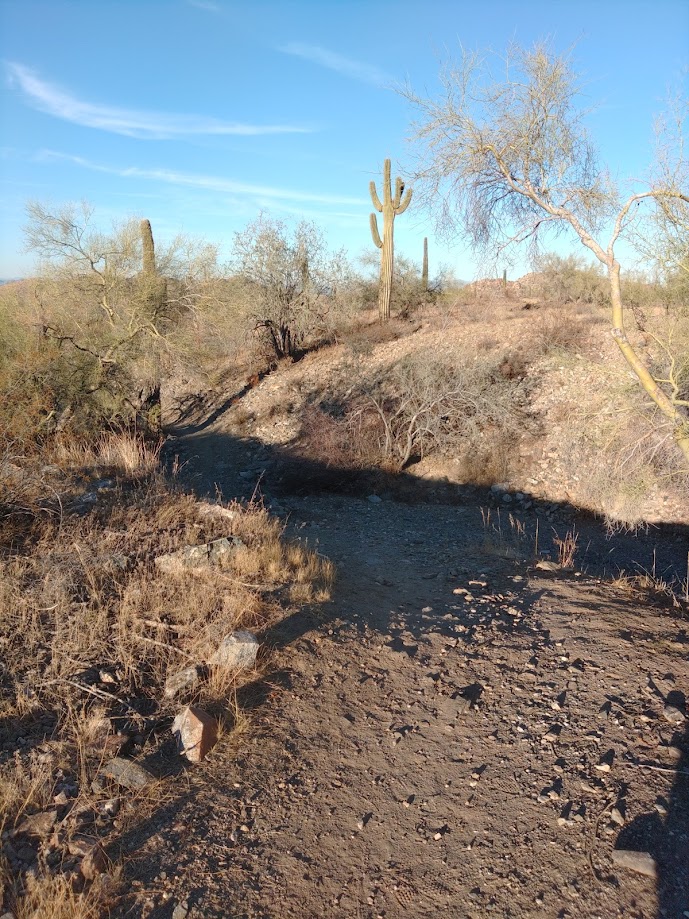
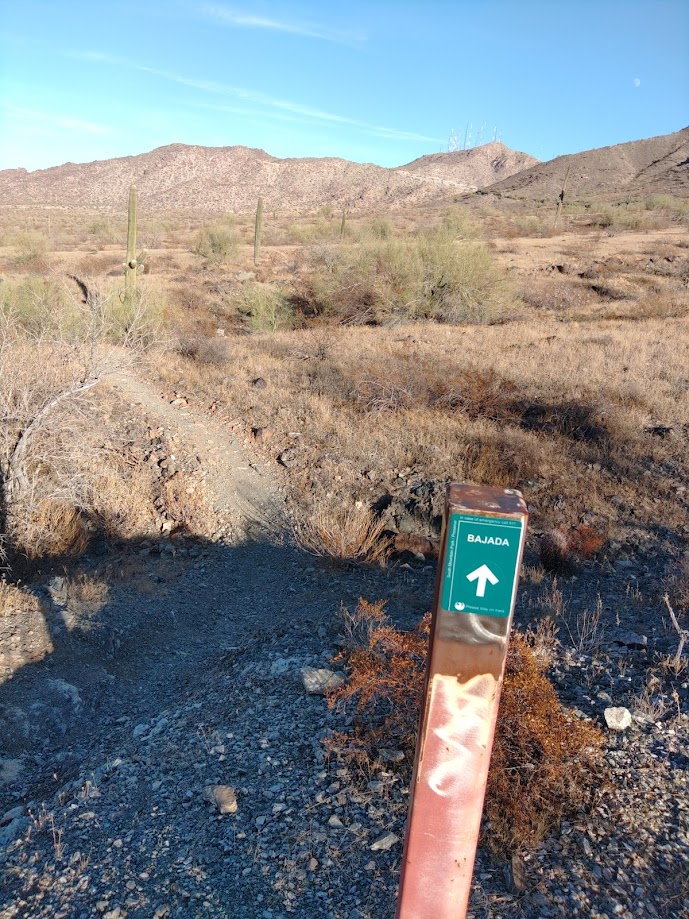
The Max Delta Trail  T’s with the Bajada trail near the San Juan Bike Center. To the right, Bajada proceeds roughly southwest to the Alta trailhead deeper in the park. To the left, the section I wanted went roughly northeast, toward my car.

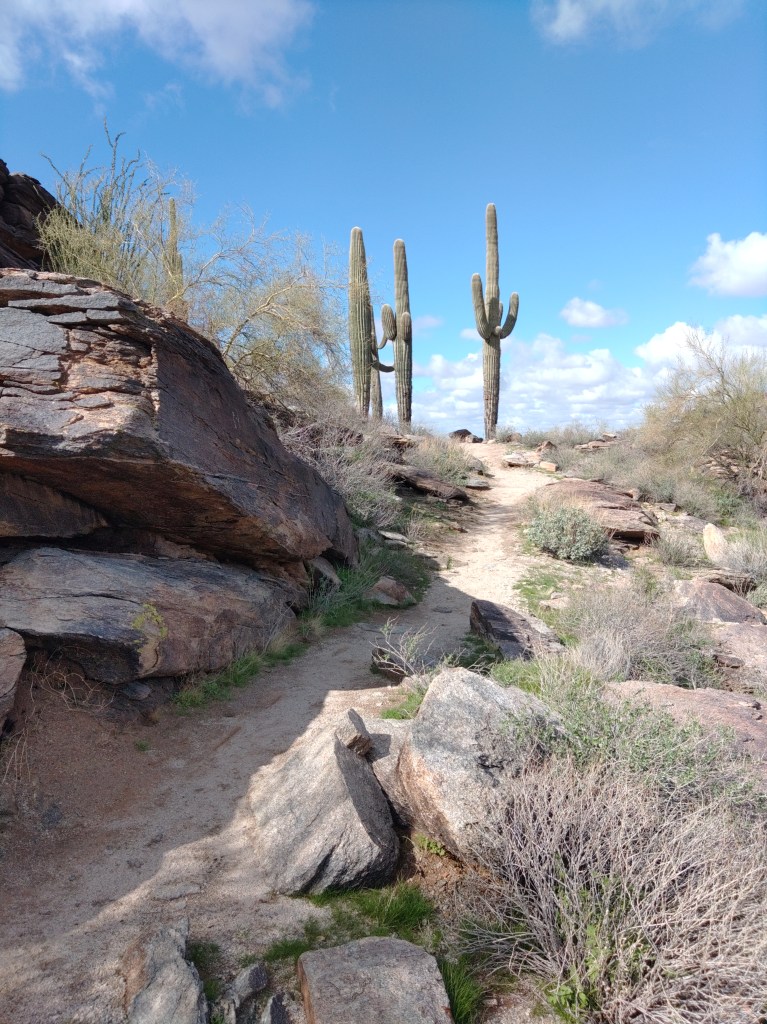
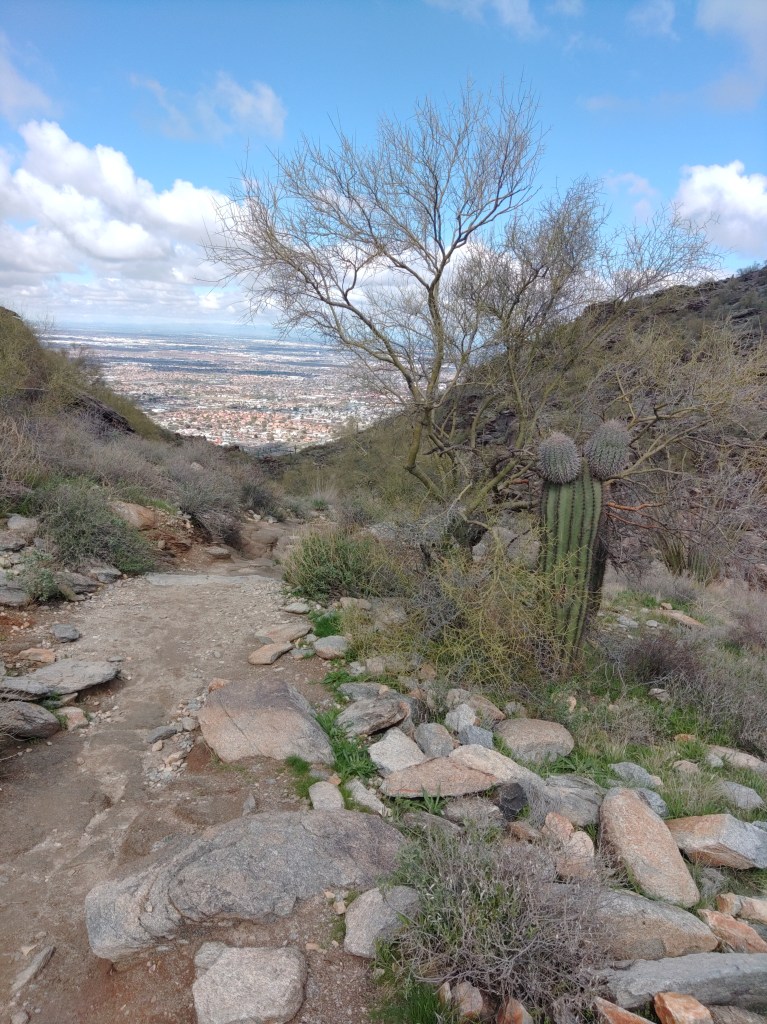
Most of this portion of the trail follows the mountainside just below Dobbins Lookout Road, so this is not a wilderness experience at all. But oh my – lookit the city out there to the north. The trail picks it way across the slope for about three-quarters of a mile before turning north and downwards. Soon, it will merge with the Ranger Trail. By this point, has widened into a service road.

The building you are heading for is the Valley of the Sun Quarter Midget Association Race Track where they race small vehicles for reasons.

Immediately to the west of that facility, Bajada will end at a four-way junction. The Ranger Trail continues straight/down/south towards the Five tables trailhead. The Derby Loop continues left/west until its junction with the middle portion of the Max Delta Trail.

Los Lomitas Trail goes to the right/east towards the Big Parking Lot. That is the way if you are following the Infrastructure Loop.

Otherwise, you are just at the end of this trail.

Max Delta Trail

Max Delta is an entry level trail through the entrance of the preserve. It is named after the mine shaft that lies buried and officially off limits towards its southern terminus. That is another article. This is just about the trail.

This trail is part of the Infrastructure Vista Loop Hike.

From the trailhead at the entrance (across from Scorpion Gulch) the flat, wide trail winds west then south, narrowing as it climbs up the ridgeline it will follow for half its’ distance.  Your first landmark is a monument and plaque commemorating the city elders who re-designated the park into a Phoenix South Mountain Preserve.

If you’re new here, Phoenix was founded by developers who eventually become old and rich philanthropic preservationists determined to protect the precious desert from the new wave of developers. Somewhere in the 1970’s, 1973 – by the plaque, the old developers city elders started designating the “park” as a “preserve”.

Litigation followed. But here it is, still more -or-less preserved.

Heading south, the trail intersects with the interpretive trail behind the old visitor’s center. This is one of the last of the original CCC buildings that still sees actual use.  Looking out, you can easily see the new visitor center in the distance, and the work compound just across the street. The old administration building still has restrooms and water available to the public. The small ranger office and gift shop it once house have moved elsewhere.

The gunfire you hear from the far side of the ridge is not random. There is a gun range on the other side, both the private Phoenix Rod and Gun Club and the Phoenix Police training range.  These have been here since 1948, when these slopes were still a “park”. They expanded somewhat contentiously in the 1990s, closing the trailhead on the terminus of 7th Ave at Olney.

They are not supposed to shoot hikers, even accidentally, even hikers off the trail, but the party investigating will be the one most likely to have shot you, so stay on this side of the ridge.

Climbing down from the ridge you cross low hills with patches of barrel cacti, then saguaro then teddy-bear cholla. The trail goes down into a wash and Y’s on the far side. Max Delta proceeds south, to your right. To the left, the trail crossing the road is the Derby Trail aka Los Lomitas. You can take that turn and shave a good 40% off the loop hike. But for now, we follow the Max Delta.

The dirt turns grey as the trail crosses the arroyo, finally a bit away from the road.  You will cross another road, along with numerous washes, but it gives brief illusions of crossing open desert. Look for mine pits along the way.

The gates were closed at the San Juan Bike Hub, as this was not the first weekend of the month. It’s not closed to people, but certainly closed to vehicles. Even on the special weekend, it just affords closer parking to those who want to hike or bike down San Juan Road – which is another article.  There are some amphitheater seats which were not shaded in the afternoon by the large metal canopy, a trash receptacle, and a good number of empty parking spaces for both bikes and cars. I was the only person there when I arrived, and took a break there, surrounded by this rust-colored monument to municipal expenditure.

Then I proceeded east down the Bajada Trail to continue on with the loop.

Scorpion Gulch

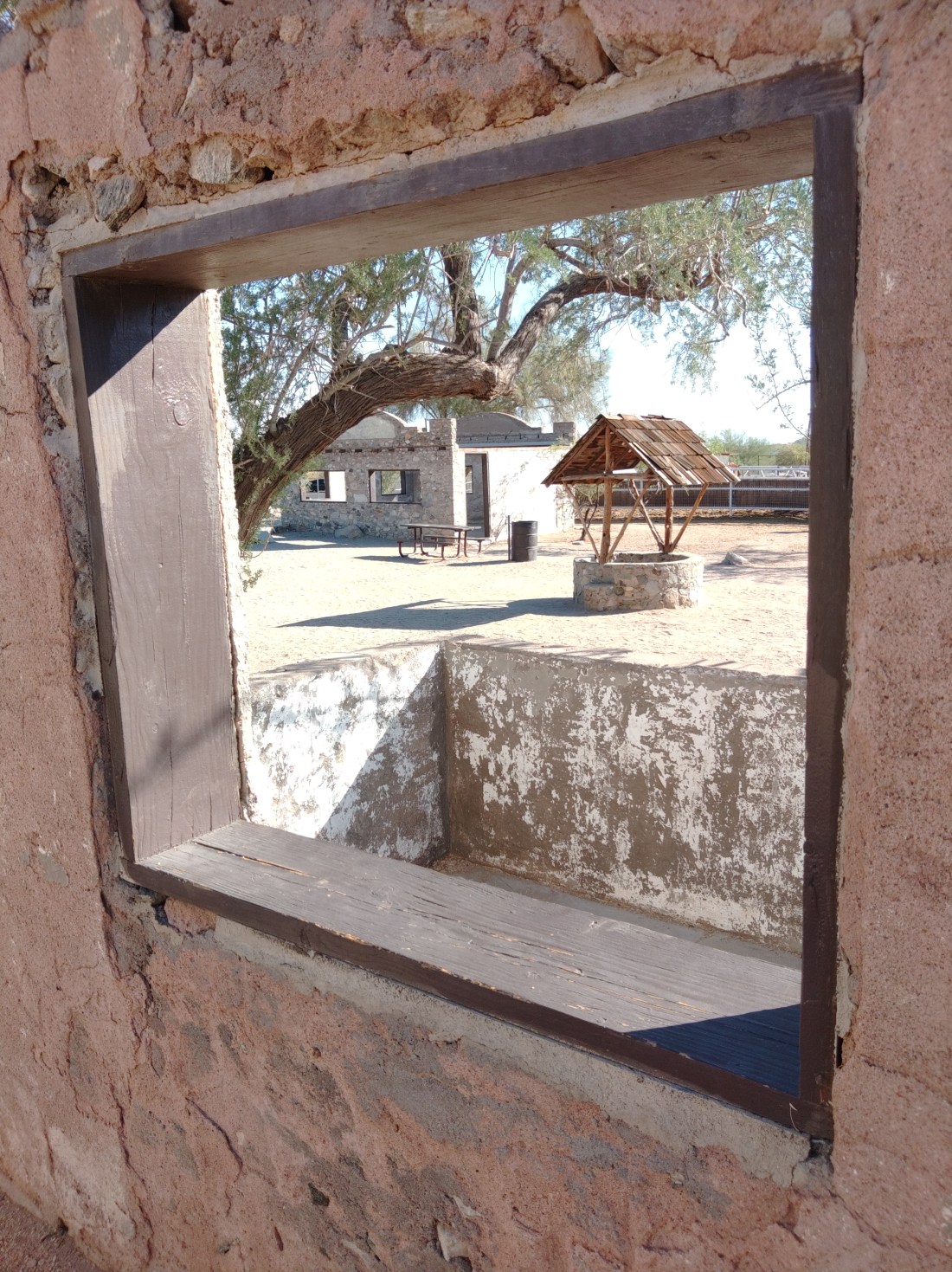
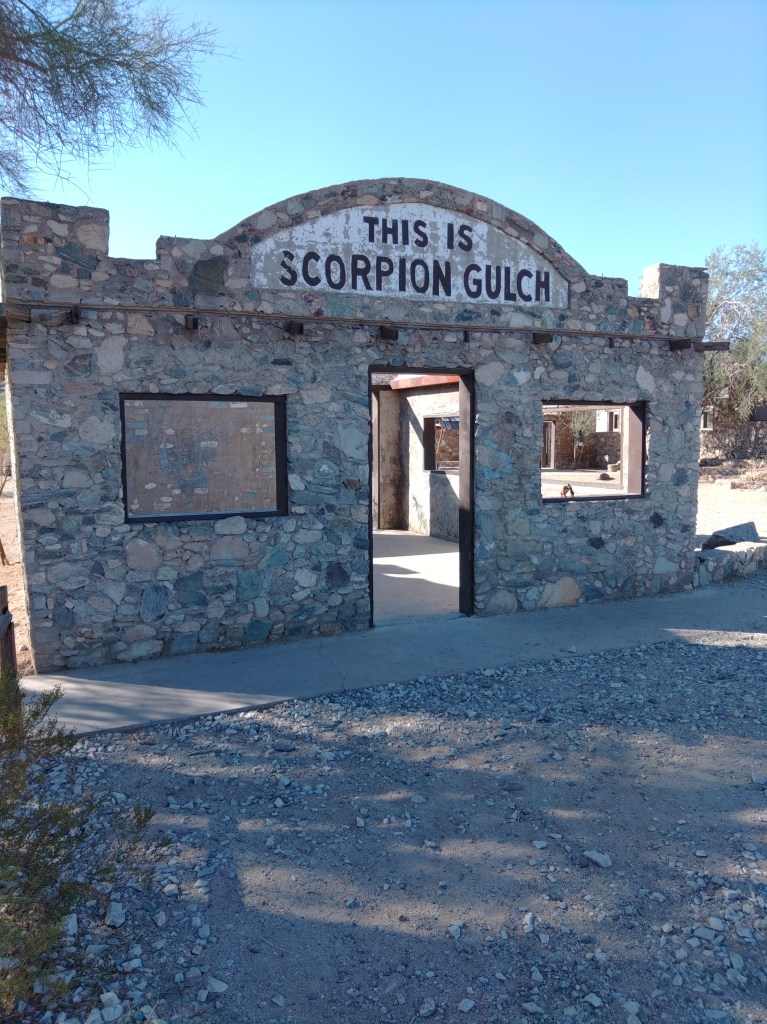
Near the main park entrance stand the stone remains of Scorpion Gulch. Visitors are free to wander in and around the two stone buildings and the dirt area between them. It is quite popular for photography, especially at sunset.

William Lundsford – Phoenix Gazette 1966

Scorpion Gulch was built as the home and the storefront of William Lundsford, who first came here with the CCC. Lundsford purchased 100 feet of frontage road in 1936 and built these structures with his own hands. For decades he ran a curio/gift/convenience store along with a cactus garden.  According to an oft-quoted 1966 Phoenix Gazette article, the local kids (presumably of what was then the small town of Laveen) called him “Grandpa”.

While Lundsford claimed to have the copyright on “Scorpion Gulch” named for the prefusion of scorpions that could be found in the wash beyond, most of the early photographs show a sign saying South Mountain Trading Post. They also show it with a roof.

After Lundsford passed, the building was briefly a bar in the 1970’s, abandoned, and then became annexed into the park. The city “stabilized it” in 2012, removing what was left of the crumbling roof and adding some strategic concrete reinforcements.

Across the road is the trailhead for the Max Delta Trail.

Scorpion Gulch circa 2009

This post is part of my ongoing Phoenix South Mountain series.

The South Mountain Infrastructure Vista Loop

This is a half-day hike within the Phoenix South Mountain Preserve. This is a sub-hub for that overall hub page.

This half-day hike combines three established trails and a bit of mild bushwhacking  to make a circuit of the south-central portion of the park, where most of the development is located. As described, the circuit takes the Max Delta Trail south and west to its junction with the Bajada Trail. Taking the Bajada east we turn north to it terminus with the Ranger Trail, then shortly its junction with the  Los Lomitas Trail. We take the Los Lomitas east and then north again, where it merges with Box Canyon Trail, to dump into the parking lot, completing the circui

I parked in the expansive Environmental Center/Ranger Station /Event parking lot and then bushwhacked roughly north, across the big wash to Scorpion Gulch, then across the street to the Max Delta trailhead proper.  It is not hard. Many have done this before you, but it is not an official route.

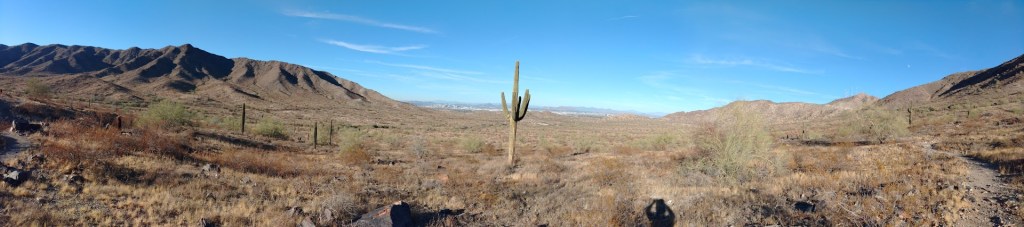
Panoramic view from the Bajada Trail

All three of these hikes are moderate and easy to access. Moderate means you can do these in tennis shoes, but not sandals. They are not, as the name suggests, quality wilderness experiences. It is more of a walking tour of the municipal portion of the park.  You can take non-hiker-hikers on it, and see some desert, and never be more than an hour from rescue and two hours from some sort of toilet.

Max Delta across 2.2 miles, will take you along the entrance road, past the old park HQ, then south across a short stretch of open desert to the San Juan Bike Center.

Bajada Trail, at least this mile of it, heads east, following the mountainside below Telegraph Pass Road before turning south to connect with the Ranger trail, and then the junction with Los Lomitas.

Las Lomitas, over the roughly 2.5 miles, winds through the various ramada compounds before merging with Box Canyon trail and dumping out alongside the accessible trail to the parking lot.

That’s just under six miles total. I did it in four hours hike time, while taking notes and pictures.

Hike date: 23 November 2023

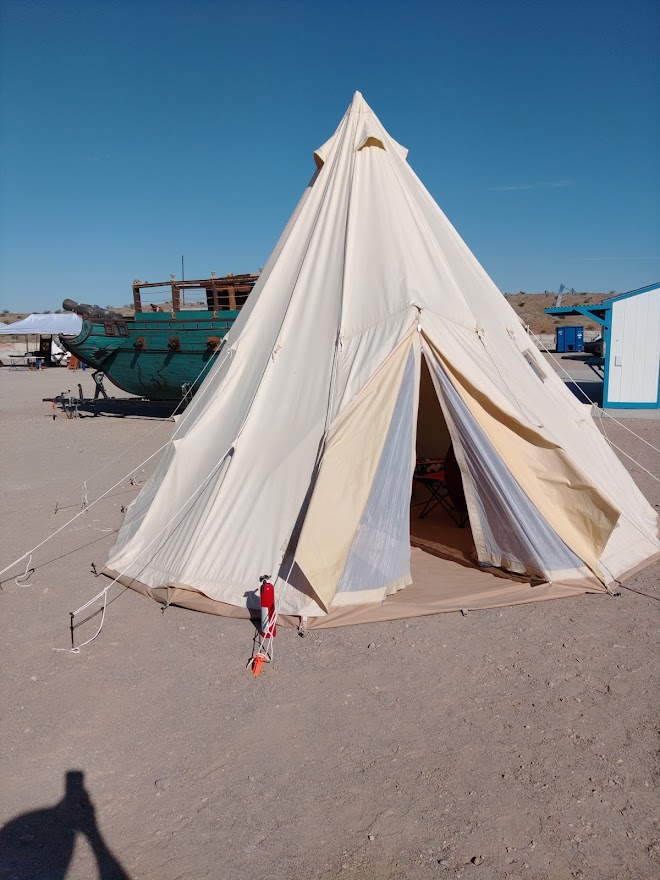
My Danchel tent is really a teepee but not a teepee.

Our Danchel Teepee at the Kingman Rodeo Grounds for the London Bridge Renaissance Fair March 2023

In my personal blog, [What Have We Learned?] I have intermittently chronicled our acquisition of the Danchel 6m Bell tent. [Here, then here]This was in error. We have no such tent.

The Danchel Bell Tent that we do not own.
Not our tent – at all.

In our defense, when we acquired this thing, it had no documentation, and no poles. Just the tent fabric and a storage bag.  And it was already several years old.

What we have turns out to be a Danchel 5.5m Teepee tent. We learned this setting up at a Renaissance festival (as we do) and our neighbor recognized the contraption. 

A review of said teepee. If only I had found this sooner…

Danchel does not seem to sell this style anymore, certainly not in the US market. They may be available in Asia, as “Indian tents”, which could refer to the type of canvas used rather than the style. These were old websites, though.

It is not actually a teepee in the sense of the traditional native American tents. Those would have several poles spread out along a circle and then brought together at the top to form the iconic cone shape.  [Notes from the Frontier has a good write-up].

My tent has a single pole in the middle. It’s the second one I bought for it, and it’s still too short, being specific to the Danchel Bell tent. I don’t believe I could reliably purchase the proper pole, nor do I want to sink any more money in this, so I adapted.

Before I learned that the pole was simply too short, I went around in many circles trying to conjure a method of removing the droop from the sides.

None of them worked.
Because the pole was too short.

The answer is actually easy – both sets of loops can make to a guy stake that I try to place about three feet out.  I have found that in good weather, I only need to make the top row.

This revelation also explained why I could never find the loops and holes for the doorway frame that is a feature of Bell tents. Yes – I bought one of those as well. The teepee has no holes or loops for the A-frame it does not need.

So I have an A-frame for a 6m Danchel Bell tent in my garage, and if you need it contact me. It’s yours for cost of shipping.

I also still have those stupid wooden stakes, but I will find a use for them.

Like their bell tent, the Danchel teepee features a zippered-in heavy-duty bathtub floor. Currently, all of that zip hardware still works.  The floor can be completely removed if you want.

In the Bell tents, it is possible to hike up the walls a couple of feet to provide a more ventilated shade structure. The teepee does not have those means, though it could likely be done by just roiling up the side sections and clipping them.

We haven’t tried. At fair, it is both dressing room and sleeping quarters.

It comes with a flap for your stove vent, but we have sewn over that burn-damaged flap. We do not camp in the snow.

Now that we’re done with what not to do, here are some best practices I can recommend.

You really, really have to dry this thing – somehow –  before storage. You do not want to store it wet for any longer than it takes to drive to someplace sunny and open.

I use the 12” heavy duty tent stakes, the ones that look like giant nails. Anything less will frustrate you when you are trying to convert the dirt parking lot of a rodeo ground into a renaissance market.  I can usually get them in and out with a straight claw hammer, but I carry both a 8lbg sledge and a 3’ crowbar, and have used both on occasion.

It is also well to have something bright to wrap around your guy stakes, as they are trip hazards even in the sober daylight. I use a pair of bright orange ratchet straps. I also use a ratchet strap instead of a guy line for the loop over the doorway. This is a hangover from when I tried to incorporate an A-frame, but it is also more stumble resistant.

Here’s the video I did not put on You-Tube about inserting the pole.

This goes for any tall pole in a tent.

I use an 8” wooden apple-box to prop up the bottom of the pole. It is the stand where the water bottle and toilet paper (two things you should always have in a sleeping tent) always return to.

The last time I kept track it went up in 90 minutes and went down in 50.  Yes – I got it back into the bag – dry.

The reluctant history of Homolovi State Park

The San Francisco Peaks west of the state park

Before I get into this article about the ruined houses of native Americans, let me confess, for context, that I have long been bored with the subject. As a native (meaning born in Phoenix – not Native) and thereby a product of Arizona public education through the 1970’s, I joined my classmates as we were herded by busloads through the various ruins scattered around a two hour drive from metro Phoenix.

These are not hard as day trips go, and low-hanging fruit for educators: here are their mud and stone structures or pit houses – and they all used to live here and did things – some of which we know, the rest we guess about – and then they all disappeared – before white man arrived (they always add that) – and now we can look at their old houses from a respectful distance.

Just like the last ones we visited, only they are over here, and look like this. If the nerds in class are bored with this (and I was a poster-quality nerd), all of the kids are bored with this.

Consequently, as an adult, I swore off Native American ruins as a destination.

This lasted until I had kids and started dabbling in travel writing.

Another thing these places have in common is visitor centers with maps and bathrooms.

Bongo at the Homolovi AZ state park visitor center

I arrived at the visitor center at Homolovi State Park at 4pm – an hour before they closed their gates. The ranger their took my $7 entry fee, and said I probably had time to see the main ruins: Homolovi II at the end of a road winding through the dry prairie for about two miles north of the visitor’s center.

Of the five known sites, only two are open to visitors. Homlovi II is the larger of the two. Homolovi I is close to the campground – yes people camp here – all year. It’s $20/night for most spots. The campground has restrooms, and even showers, but, like the rest of this ecozone, zero shade.

I saw RV’s scattered across it in early February. I don’t know why.

The state park is a joint effort with the Hopi Tribe, whose reservation lies about 60 miles north of here, in the middle of the sprawling Navajo reservation. Neither tribe thought this was a good idea, and the Feds didn’t care. Thick books have been written on how this happened and why its stupid. I don’t have time to get into that here – but this guy took the time, if you care.

According to the state park website:

The Hopi people of today still consider Homolovi, as well as other precolumbian sites in the southwest, to be part of their homeland. They continue to make pilgrimages to these sites, renewing the ties of the people with the land. The Hopi tell us that the broken pottery and stones are now part of the land and are the trail the Bahana will follow when he returns. Therefore, these are mute reminders that the Hopi continue to follow the true Hopi way and the instructions of Masau’u.

https://azstateparks.com/homolovi/

The website does not go on to explain who or what the Bahana is, and while we can guess by context, it does not expand on the concept of Masau’u. None of which is surprising.

The Hopi Tribe is notoriously insular. They allow visitors to their reservation, but only in the approved hotel, and you cannot wander around, and not only is photograph prohibited, but note-taking is prohibited.

I think in 7th grade a public school teacher told us that every year evangelical Christians would send Christmas gifts to the Hopi reservation, and every year the Hopis would, “toss them over the cliff”. I don’t know if that still happens, or for a fact if that ever happened, but it sounds plausible that it happened at least once. I’m pretty confident, though, that you can replace the cliff part with a dumpster of some sort.

So those guys – those guys – partnered with white man (then Governor Bruce Babbit in particular) to preserve the dwindling remains of these sites, as pot hunters were starting to come in with construction equipment.

And having driven that road and walked along the couple hundred yards of sidewalk to and around Homolovi II I can report that those ruins are – unimpressive. A couple of small dwellings and one large ceremonial structure have been excavated so you can take pictures (that was part of the deal) and learn that they – favored rectangles.

Rectangles!

Full disclosure: I did not have the time to go through the interpretation displays in the visitor center – which take up slightly more space than the gift shop portion, nor did I download or otherwise listen to the interpretive audio feature.

As much as I claim disinterest, I did do some reading.

Somewhere in the 1200’s flooding along the Little Colorado (which marks, roughly, the western boundary of the park) deposited big piles of driftwood. Ancestral Hopi (I’m using a consensus term that is also easiest to spell) migrated out from the Mesas and used that driftwood for building and burning, establishing several villages along the river. They grew cotton and other crops in the alluvial soil until sustained drought in the 1300’s drove them back to the Mesas.

That same drought did in a lot of cultures around the southwest. I learned that in the 70’s.

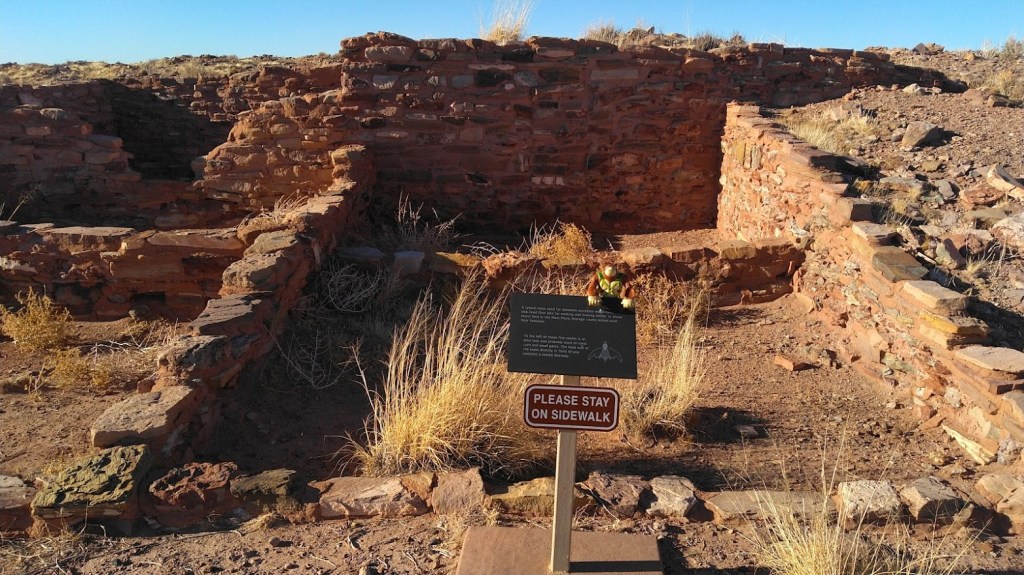
Ancestral Hopi took the trouble to destroy their homes, particularly ceremonial sites, as they abandoned them. Vandals and looters also did their share of damage. Unlike the towering ruins at say Wupatki or Walnut Canyon, all the average eye will see is a pile of rubble of what was once a sizeable complex of structures. Except for the small portion the state park excavated so I could pose my plastic gorilla in front of them and take pictures.

The sidewalk to peace and quiet

I do not have Hopi ancestors to commune with. In fact, I have very little spiritual awareness – I don’t feel Vortexes around Sedona or any of that. I believe the spirit world is like the New Jersey mob: not a player, not a target. This buddhist has enough complications in his life.

I did feel the abiding peace that comes with those barren, rust-colored hilltops – near silent save for the wind. That may be typical of the whole region, but I paid my $7 – so I could feel this without trespassing.

Micah Loma’ovaya, an archeology student working on the site wrote this in Southwest Archeology in the Fall 2000 issue:

“Going home on the weekends allowed me to recount for my grandparents and other relatives our weekly discoveries. Many parallels between Homol’ovi and Hopi were found, and my learning expanded, not only in archaeology, but in my own culture as well. It seems that as Hopi have progressed along our cultural continuum, we have tended to lose focus of the true meanings behind our behavior. […]

“In Hopi culture, we understand that ancestral places were marked with footprints (ruins, artifacts, and burials), monuments to our prehistoric occupation, that would be attributed to us one day. Now we must participate in retracing those steps leading to Hopi society and be willing to acknowledge the fact that we have a history to share.”

Micah Loma’ovaya
Archeology Southwest, Fall 2000 pg 10.

I’ll leave on that, before the ranger closes the gate.

[Micah Loma’ovaya has gone on to become an archeologist and apparently a realtor. His Linked-in bio.]

Homolovi State Park is located just north of I-40 and Winslow on AZ 87.

Google map:

https://g.page/homolovi-state-park?share

The park is open year-round.

Day Use/Visitor Center/Exhibits/Park Store

8:00 a.m. – 5:00 p.m. daily
Thanksgiving: 8:00 a.m. – 2:00 p.m.
Christmas Eve: 8:00 a.m. – 2:00 p.m.
Christmas Day: CLOSED

Park Entrance Fees

Per vehicle (1-4 adults): $7.00
Individual/bicycle: $3.00

The water works of Tres Rios

Photo from city of phoenix website

Tres Rios Wetlands Environmental Restoration Project is the outflow from the city of Phoenix water treatment facility that they have made into a public park. No – the water’s fine. It’s already treated before you can get anywhere near it. They won’t let you swim in it, but they will let you walk around (with a free permit) and fish (with a paid permit).

One path through here is a segment of both the Sun Circle Trail, a bike route that runs around most of the cities in the metro area and the Maricopa trail, which circumnavigates the entire metro area. [They have an interactive map!} Also, it is a local hike, and the day (30 Jan 2022) was great for local hiking.

My route would start at Tres Rios, then follow the trail past it, westwards along the Salt Riverbed to its confluence with the Gila river, near the Base and Meridian Wildlife Area. I would return the way I came.

Tres Rios has a gravel parking area, a single plastic outhouse, interpretive signage and large trashcans. There are no other services.  The large trashcans represent a futile attempt to keep fisherfolk from leaving their fishing garbage all over their fishing place.

The city says this of the project:

The lush and scenic Tres Rios is now home to more than 150 different species of birds and animals like muskrats, raccoons, skunks, coyotes, bobcats, and beavers. The beautiful cottonwood groves, willows, mesquites, and other desert shrubs around the reed-lined ponds and along the trail attract many migratory and wintering songbirds. By bringing the Salt River back to the condition it was in during the early 1800s, this project is repairing a natural habitat. 

The reclaimed water from the wastewater treatment plant is pumped over to the wetlands, and the plants and animals take what they need before it is discharged back into the river.

Like the 1800’s only now, and with more plastic trash

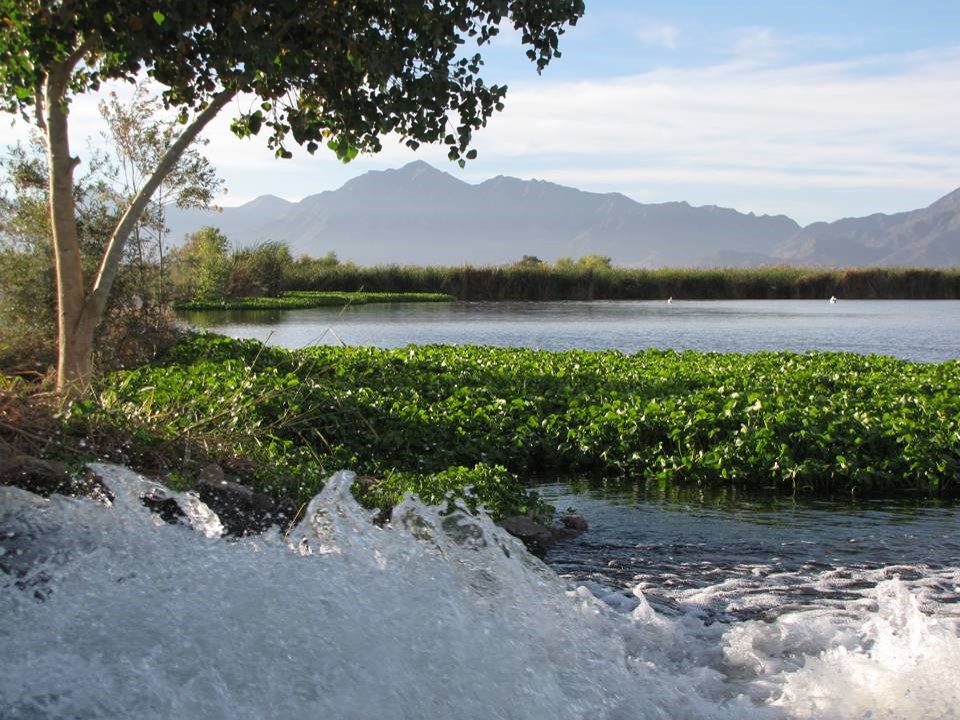
From the parking lot, three trails (wide graded dirt roads really) proceed westward in parallel. The center one, with the signs, if the official course of the Maricopa Trail. It also seemed the most crowded in the late morning, but also had the better of what scenery there was. To the north are the lagoons, and to the left, after the first half mile, is the mesquite bosque. The trail also passes the “waterfall” where the lagoons discharge into the Salt Riverbed.

The north track has those same lagoons to its south, and open farm fields to its north.

The south track had brush to the north and the normally dry portion of the Salt River to the south. It also features zero shade.

I had dutifully applied for my permit, and had it ready to show on my phone, but there was no evidence that anyone enforces that. All the numerous “No Trespassing” signs about the place – that means people without permits.  Or visiting after dark- park hours are dusk/dawn.

Several concrete causeways separate the various lagoons, and these can be crossed on foot. I’m not sure if you are supposed to, but fisherfolk clearly do this all the time. But beware, At least two spillways on each causeway guarantee a water hazard.

Past the lagoons, the north and center roads converge, ending in a turn-around marked by giant concrete pipes. To the north of these pipes, the Maricopa trail continues, intermittently following the remnant rod, or making its way as a dedicated footpath.

I dutifully followed the marked trail on my way in as it hugged the great wall of caged rock that marks the northern edge of the Salt’s flood-zone. I followed a series of dirt roads on my way back and found that I did not miss the trail at all.

The trail closes in on the riverbank just as you reach the boundaries of Base and Meridian Wildlife Area. B&M is primarily a fishing spot. It shares parking with the Phoenix International Raceway. From that parking lot, a bridge crosses a wash to land onto a paved road bisecting the riverbed. From this road all manner of dirt roads and trails fan out to various fishing spots.

Due south of the parking lot is monument hill, where the geo-marker forming the basis for the state’s survey lines is located. Alas, it is also possible to glimpse into the raceway from that height, so the hill is now fenced off. It’s not much of a fence, but you would be on your own with that. I tossed the garbage I had collected on the trail into the trashcans provided at the trailhead and turned back.

I found the actual confluence, where the Gila, maybe ten feet across at that point, burbles into the Salt, fattened to hundreds of yards across by the Tres Rios discharge.

One of the dirt roads bisects an island in the middle of what would not be the Gila River, and I was able to sit quietly on the bank and listen to one fisherfolks Tejano music battle with another’s rap music battle with oldie-rock being covered by whatever band was playing whatever even went on at the raceway.

Remember that you are, at either trailhead, walking distance from a convenience store. This will not be a wilderness experience.

Even so, I did find some measure of peace and quiet. On my return, following the dirt roads closer to the river, I encountered nobody for the better part of a mile, and was able to even sit by the river in peaceful reflection, doctoring a blister. That moment alone kinda made the trip worth it.

I did not bother to GPS this, but ten miles round trip feels right. You could probably do it in eight miles if you did not wander. I was on the trail about five hours.

Ten seconds of water in the desert

Chasing the ghost of Old US 80

After finishing day-job business early in Yuma, I realized that I did not want or need to take the [yawn] I-8 to AZ85 to I-10 back towards Phoenix.

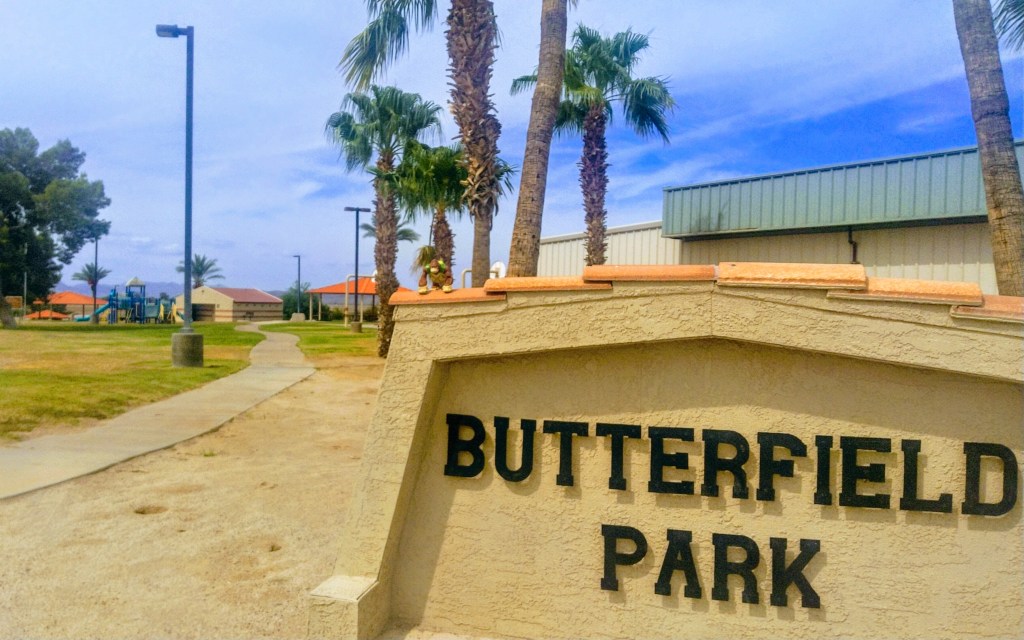
Interstate 8 replaced the old US 80 through this part of the state. US 80 replaced the Butterfield Stage Route. The actual Butterfield stage only ran a few years (1857 to 1861), but their route held onto the name. It was the wagon route from Phoenix to Yuma.

Bongo in Wellton, AZ, on old US 80.

The stage route benefitted from the work of the Mormon Battallion who beat the path from Santa Fe to San Diego, including what had long been known as the Gila Trail to Spaniards and other locals.

It’s flat desert. Follow the river as long as you can until you have to cut across to the mountain pass. Not a lot of cause for innovation.

This obvious route became part of the Dixie Overland/Lee/Bankhead/Ocean to Ocean/etc. Highway by the 1920’s, when the Feds, finally taking an interest in highway construction, decided they needed numbers. The number for this jumble of routes was initially US 80.

As Us 80 meandered across the state, if followed the old wagon route (as did the railroad line) until around what is now Gila Bend, where it bent north towards Phoenix. The original stage route bent southeast towards Tucson. Phoenix was barely a settlement in the 1850’s.

Butterfield wagon ruts are long gone, but parts of actual US 80 exist, much of it as an access road along Interstate 8. We start along there.

At Telegraph Pass, I-8 winds through the Fortuna Foothills to descend into metropolitan Yuma. These mountains are prime habitat for both Border Patrol and the Arizona Highway Patrol. Just saying. US 80, as an actual paved road you can drive, starts on the east side of this pass at the Ligurta exit.

I had lunch at some small place in Wellton where I ate my fast-food quality sandwich while trying not to listen about the Local Loud Trumpster expound on his theories to two poor women listening politely. I was happy not be included in that conversation. (I have different ideas). I was happier to leave.

Parallel to I-8, US 80 is a two lane highway with a speed limit of 65-ish. To the south, train tracks and beyond, the mighty interstate. To the north, you can see what farming in the southwest desert looked like right before the water ran out. North of that is the zombie bed of the Gila River.

We didn’t write about this little landmark, but you can read about it here.

The quest for Wellton Pond

I came across a sign saying Wellton Pond 10 mi. Had a little fishing symbol. I was ahead on time, so I took the right off of Old US 80 on Avenue 45E and headed due north  for about 6 miles, crossing the Gila River bed. Following another sign, I took the right (east) on County 2nd Ave for another 5 miles until I found the pond at the junction of 2nd Street and Ave 50 East.

Wellton Pond is not on the map. Following signs as I did is about the only way to find it. It is a small hole full of water, choked by a wall of brush. I do not know who owns the property, but there were no barriers to access other than the brush. People clearly fish here. The farm field adjacent had an outhouse, for which they have my gratitude.

Once I had satisfied my curiosity with the pond (perhaps so you don’t have to) I continued east on 2nd Street until it bent south, becoming Avenue 52 E and, once back across the Gila, graded dirt until its eventual terminus with Historic US 80 just as that terminated back into Interstate 8 near the Mohawk rest area.

Bongo finds Wellton Pond so you don’t have to.

Sentinel

This is one restaurant that did not close due to COVID.

Sentinel proper is north of its exit from I-8, but the part I visited was to the south.

In truth, I wanted to see the Sentinel Plain Volcanic Field, but most of that is on the wrong side of the fence, inside the bombing range. You might be able to do this with a permit. I wasn’t that curious.

Back at the highway, though, you can see the remains of the Sentinel stage stop that once served bad food and brackish water to the brave passengers of the Butterfield Stage Line.

There is apparently more on this across the highway in Sentinel proper (which consists of like 6 buildings) but I had squandered too much time looking for a tiny pond.

US 80 north

Old US 80, as a separate highway, resumes on the east end of Gila Bend (past the Space Age Lodge), winding north along its original route west of the Gila River. Once again, you drive along the two-lane highway with the honor system as a speed limit, though pavement conditions will punish you if you try interstate speeds.

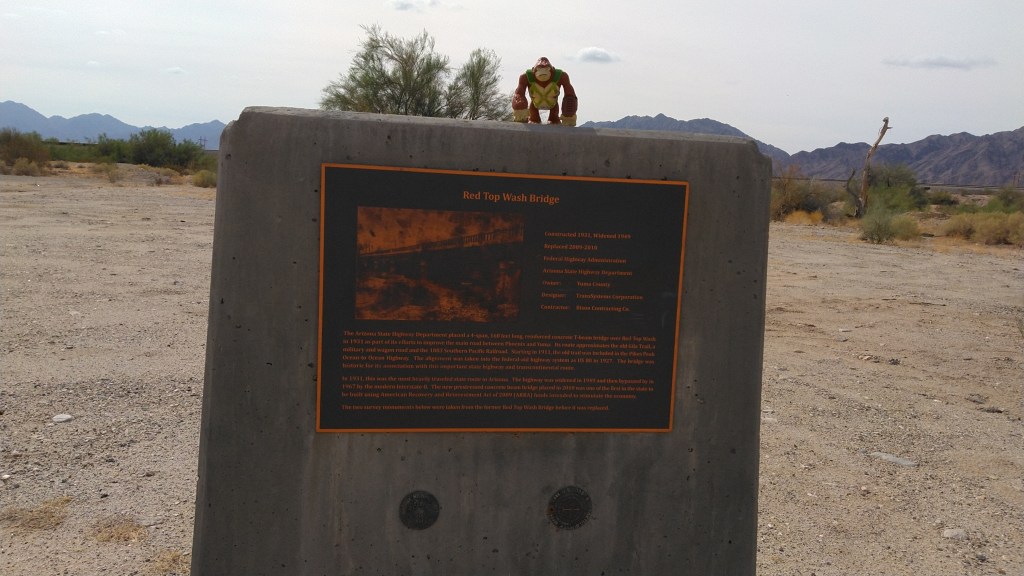
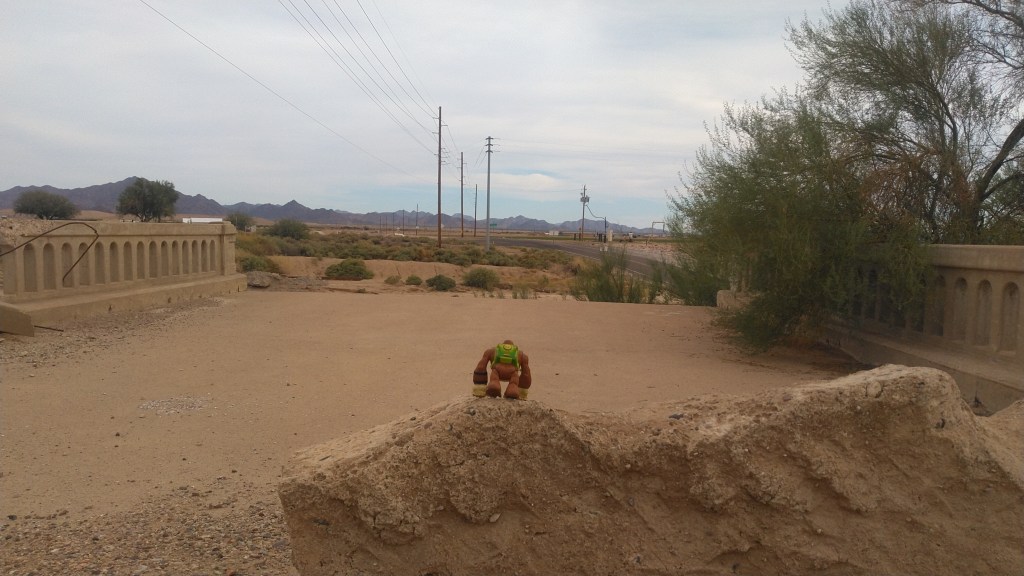
Not all the highway is original. At Rainbow Wash, I stopped to look at the bridge that once crossed the wash, back when this was a maintained coast-to-coast highway. That bridge is a hunk of concrete on one side of the wash. Beside it, the asphalt of “old” US 80 crosses the bottom of the wash, and if that’s flooded, you will have to go over to AZ 85 on the other side of the canals.

In the 1950’s, US 80 was re-routed to follow the route of what is now AZ 85, the connector highway between I-10 at Buckeye and I-8 at Gila Bend.

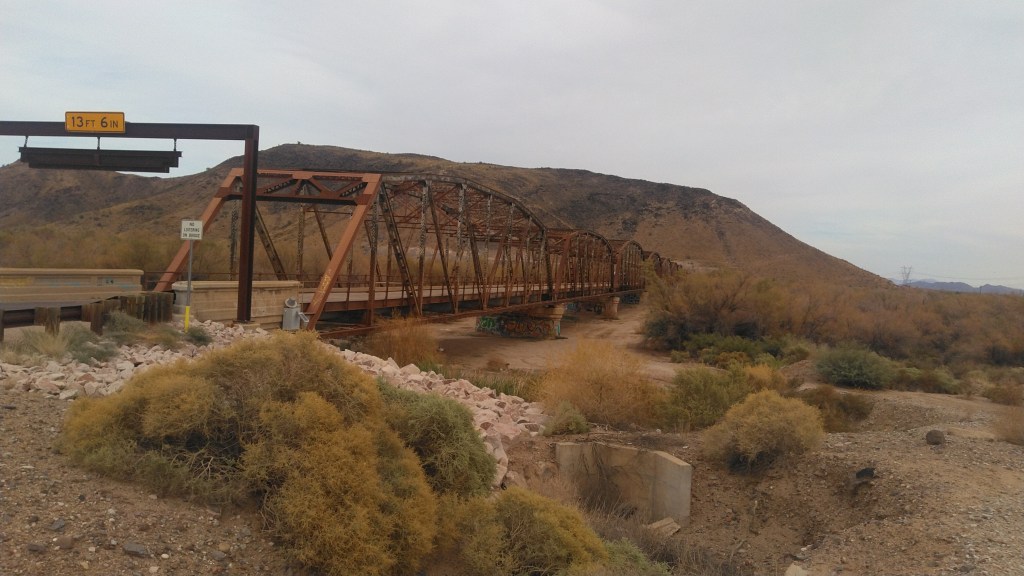
The road bends west until it crosses the Gila River (bed) at the historic Gillespie Dam Bridge.

The bridge

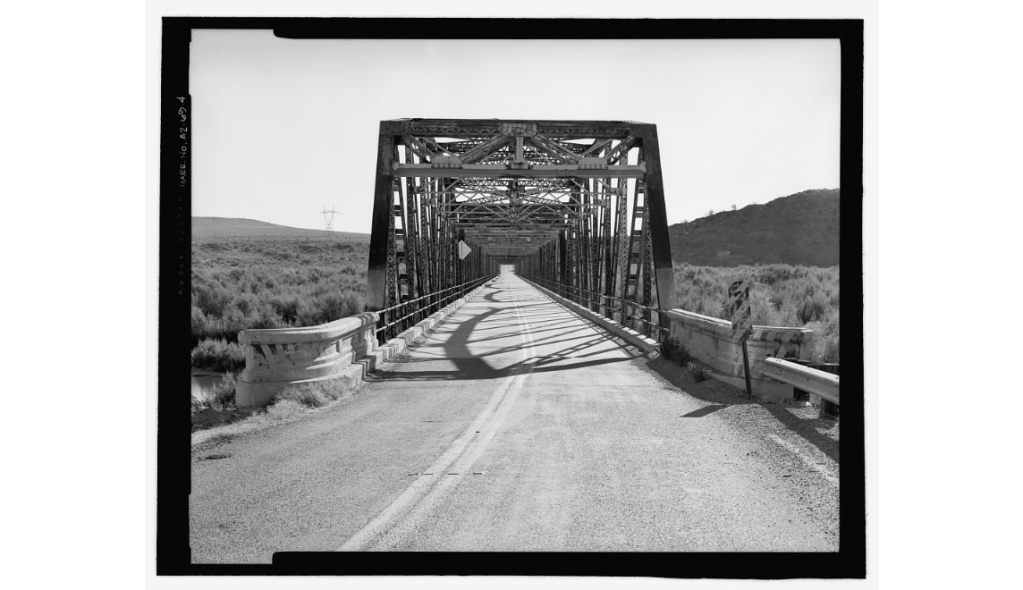
The Library of Congress notes:

Prior to completion of this bridge in 1927, traffic on the Pikes Peak Ocean-to-Ocean Highway at this point was often halted by flooding on the Gila River. The Gillespie Dam Bridge was this strategically important to Arizona transportation in that is finally allowed all-weather travel over this vital transcontinental route. Technologically, the bridge is noteworthy as one of the longest vehicular structures in the state. … In almost unaltered condition today, the Gillespie Dam Bridge is one of the most important examples of early bridge construction in Arizona.

In glory days.

https://www.loc.gov/resource/hhh.az0577.photos/?sp=4

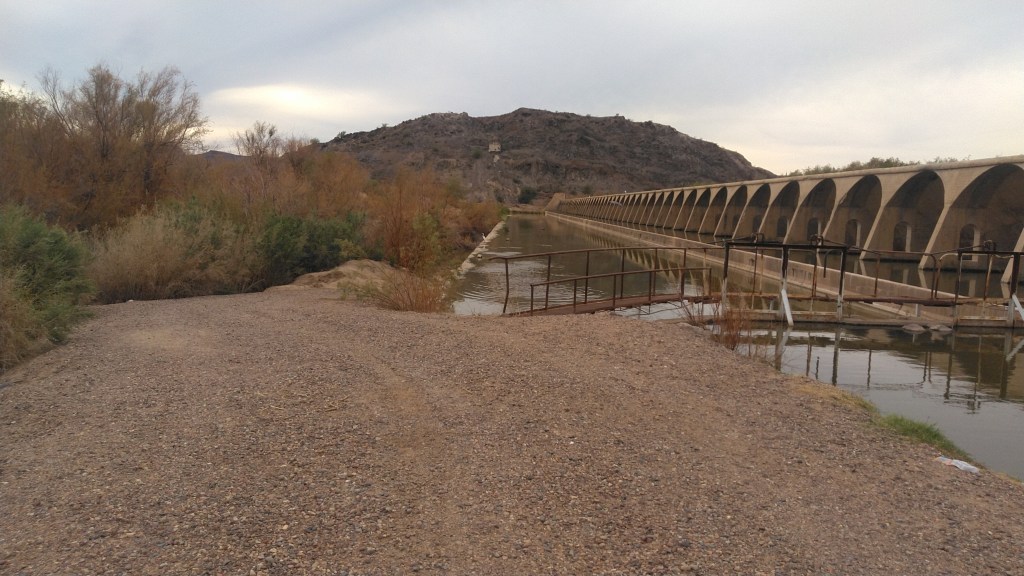
And the dam.

Together, where the Gila goes to die.

To the north, as you cross, the ruins of Gillespie dam marks the spot where the Gila river, as an actual flowing river, dies. To one side, stern fencing isolated the ports where the water flows into the machinery of irrigation. No fence stopped me from exploring the partially ruined dam on foot, among the frogs and waterfowl.

The old Highway carries on, of course, hooking around to the east through various farming hamlets until it finally intersects with its replacement, AZ85, which takes you to the coast-to-coast highhway’s ultimate replacement, the mighty I-10.

SOURCES:

https://southernarizonaguide.com/butterfield-overland-mail-stage-route-southern-arizona/

https://www.loc.gov/resource/hhh.az0577.photos/?sp=4

https://azdot.gov/adot-blog/us-80-mother-arizona-highways

https://www.americanroads.us/ushighways/ushighway80.html

https://www.aaroads.com/guides/us-080-az/

Three distinct distillery tours

We can’t hike all the time. All three of these, though, involved some walking. And drinking. We do that too.

Recently I had the opportunity to tour and partake at three different spirit distilleries in and around Las Vegas. We’ll start simple, and let things escalate out-of-hand as they will.

Desert Diamond Distillery

Just outside of Kingman, AZ, towards the airport, you can find Desert Diamond Distilleries, [https://www.desertdiamonddistillery.com] which has a tasting room, distillery tours, and monthly dinners after which you taste whatever spirit the owners are most proud of that month.

The $7 tour is simple and straightforward: You learn how the bar came from a restaurant in Las Vegas, and the rat Pack leaned upon it, you see the giant copper still from Germany,  you see the warehouse.

Desert Diamond mostly makes rum and that rum is worth the journey. They want $20-50 a bottle, and you are getting that quality.

They have been dabbling in whiskey, and that is quite good, but still quite pricey. I felt I paid $75 for a $50 dollar whiskey. But it is, by a good margin, the best whiskey I’ve found distilled in state.

They make a cheaper corn whiskey, and a vodka, neither of which I have tried.

The owner pouring you one…

Across the river in Las Vegas, the distillery experience gets bigger and crazier and more expensive.

The Mob Museum Speakeasy

In the basement of the Mob Museum, [https://themobmuseum.org] they have a “speakeasy”. This is a real bar, but you can only get into it with ($30) admission to the Museum. OK – there is some side door that you can get in with a password from the website, but we had tickets, so you are on your own with that.  For an extra $15 you can sit in on the tasting and prohibition lecture. In that setting, we learned a little about the distilling process (they make some beer, moonshine and rum on site) and a good deal more about the birth of bootlegging in the US, and how this financed the first national crime syndicates. Or so I suppose. I couldn’t hear half of it over the music from the speakeasy next door.

The samples were microscopic, and unimpressive. Moonshine is just moonshine. The rum did not stand above any of its big-batch $20/bottle competitors. I’d tell you about how they tasted in the cocktails from the speakeasy, but we stood for 15 minutes without getting any staff attention and moved on.

Las Vegas has no shortage of places you can pay too much for cocktails. (We ended up at Circa where we were served within 5 minutes on a Saturday night.)

The museum (properly called the National Museum of Organized Crime and Law Enforcement) itself is all kinds of clever, (it has won awards) but it is three stories (plus basement) of wall-wall crime and mayhem, and I burned out on which middle-aged white guy went to jail for shooting which middle-aged white guy.

Like most museums, the information comes in isolated paragraphs next to displays, but you can put together the narrative that Prohibition allowed street level gangs to become or become co-opted by national gangs, and how the feds ignored them until the 1950’s when congressional hearings (that’s the whole 2nd floor) forced them to do something. Portions of the Kefauver hearings actually took place in the very courthouse the central presentation is in. There’s a section on the mob in Vegas, and an equally large section of the string of cowboy sheriffs patrolling those same streets.  By the time Whitey Bulger was leaving a trail of bodies around Boston I had lost interest.

You can buy the moonshine for just over $20/mason jar in the gift shop. I did not.

Lost Spirits Distillery

On a brighter note, across the freeway inside Area 15, (which is an experience all of its own) you can tour the Lost Spirits Distillery [https://www.lostspirits.net ] which tries to make the distillery tour into a Disneyland experience. The problem is that they are still in a converted warehouse, and while they are clearly trying their best the compromises, like having to ride the trolley across the parking lot to the second building, are unavoidable.

They still want $55 a head.

Lost Spirits claimed to have found a method to age spirits without actually aging them through the use of light.  You can see on the tour the contraption bathed in the lights of what I happen to know are commercially made theatrical lights. However, I can’t say what sort of lamps they put in them, nor would they tell me. That’s the secret, I was told. You can also see more regular stills and get a sniff of the big barrel full of must that they keep in the open for visitors.

In addition to seeing some of the distillery equipment, there are themed rooms with tasting stations, where you can taste the various products, mostly high-proof rum. There’s a candle-lit forest, a Victorian “Dorian Grey” room, the Havana Hologram Lounge (which has some cool projections) and the submarine, which is legitimately a triumph of scenic design over budget.

Curiously, Lost Spirits does not directly sell the booze they just demonstrated on site.  They will ship bottles, when available, starting at $30/ bottle plus, plus.

Even though I am a fan of museums, scenic design and giant copper pots in all shapes, I wouldn’t repeat any of these tours again. I will assert that the distillery tour of the Mob Museum is over-priced for what it is. Lost Spirits is worth it once, as a strange date night activity.

Now, I’ve been back to Desert Diamond many times. But that is because they will actually sell me booze.

Desert Diamond Distillery

4875 Olympic Way, Kingman, AZ

The Mob Museum

300 Stewart Avenue, Las Vegas, NV

(A block away from Fremont Street).

Lost Spirits Distillery – Area 15

3215 S Rancho Drive,  Las Vegas, NV.

Check websites for times and prices.

All photos are from the websites of locations covered unless noted.

“We” for this article means Cheryl and myself. More on that on my personal blog: What Have We Learned? [https://padegimas.wordpress.com]

So, yeah, this might be becoming a more general travel site.

The Grim Beauty of the Granite Mountain Hotshot Memorial

Bongo at the trailhead.

A few weeks ago, taking the back way down from Prescott, I stopped at the Granite Mountain Hotshot Memorial off of AZ89. The State Memorial Park is located on the second serpentine wind down the mountain that separates Yarnell from Congress. It is most easily approached going south. AZ89 is split here, and you would have to U-turn past the site going north to come back and reach it.

There you will find parking for about a dozen cars and “restrooms”, meaning plastic outhouses.

Or you could take a map

The main trail is just shy of three miles one way winding up and around the desert ridges. You can expect all the low desert hazards and all the low desert heat. The grade is gentle but constant as the packed dirt path switches back and forth across the ridge, perhaps more times than is really needed. On occasion, stone stairs will help you up or down.

Along the way are shiny, stainless steel plaques commemorating each firefighter who died in this catastrophe, as well as plastic plaques explaining the history of desert fires in general, and the Yarnell Hill Fire in particular. There are also benches.

If you took a free map from the container at the trailhead, you can easily follow your progress up the 2.85 main trail by plaque. I’m not going to recount the well-known tale here. The park website repeats all the verbiage on the plaques.

If you need to know more right now, this article is a good over-view without being gushy local news or terse and technical fire-speak.  You could also read the actual report it references. Meanwhile, we are hiking.

View from the trail

Were it not for its grim purpose, the Hotshot Trail, as it is designated, would actually be a pleasant climb through a fine collection of rocks and cacti. Climbing up the ridge reveals consecutively grander vistas of the valley below. On my trip lizards scampered away from my feet as hawks circled overhead. But then I came to a glaring plaque (the afternoon sun makes them signal mirrors) and joy yielded to grim purpose.

The Yarnell Hill Fire ended for a generation the debate as to whether Prescott (where the GM Hotshots were based) and surrounding communities should publicly fund wilderness firefighting. There had been loud talk of leaving all of it to the feds. After the fire, state and municipal money carved this fine, if sad trail up the ridgeline.

The Hotshot Trail ends at an Observation Deck overlooking the site where the 19 men actually burned to death. A large plastic plaque explains how that happened. There is a bench and shade and a tribute wall decorated with a multitude of firefighter patches along with other mementos.

The much steeper Journey Trail continues from this point, tracing the route the Hotshots took down the ridge to their doom. It drops about 500 feet in one mile to reach the actual memorial. I was out of water at that point, so I turned around at the observation deck.

A week later, hand to God, I stumbled upon the movie based upon this group and their sad end, Only the Brave. It is actually well done.

If you visit this site, go in the morning and don’t go in summer. The desert wants to kill you even when its not on fire – don’t make it easy.

Sometimes it kills even the best of us.